How to Build an AI Maturity Assessment That Actually Generates Leads
Turn your framework into a scored diagnostic that delivers genuine value and captures qualified pipeline.
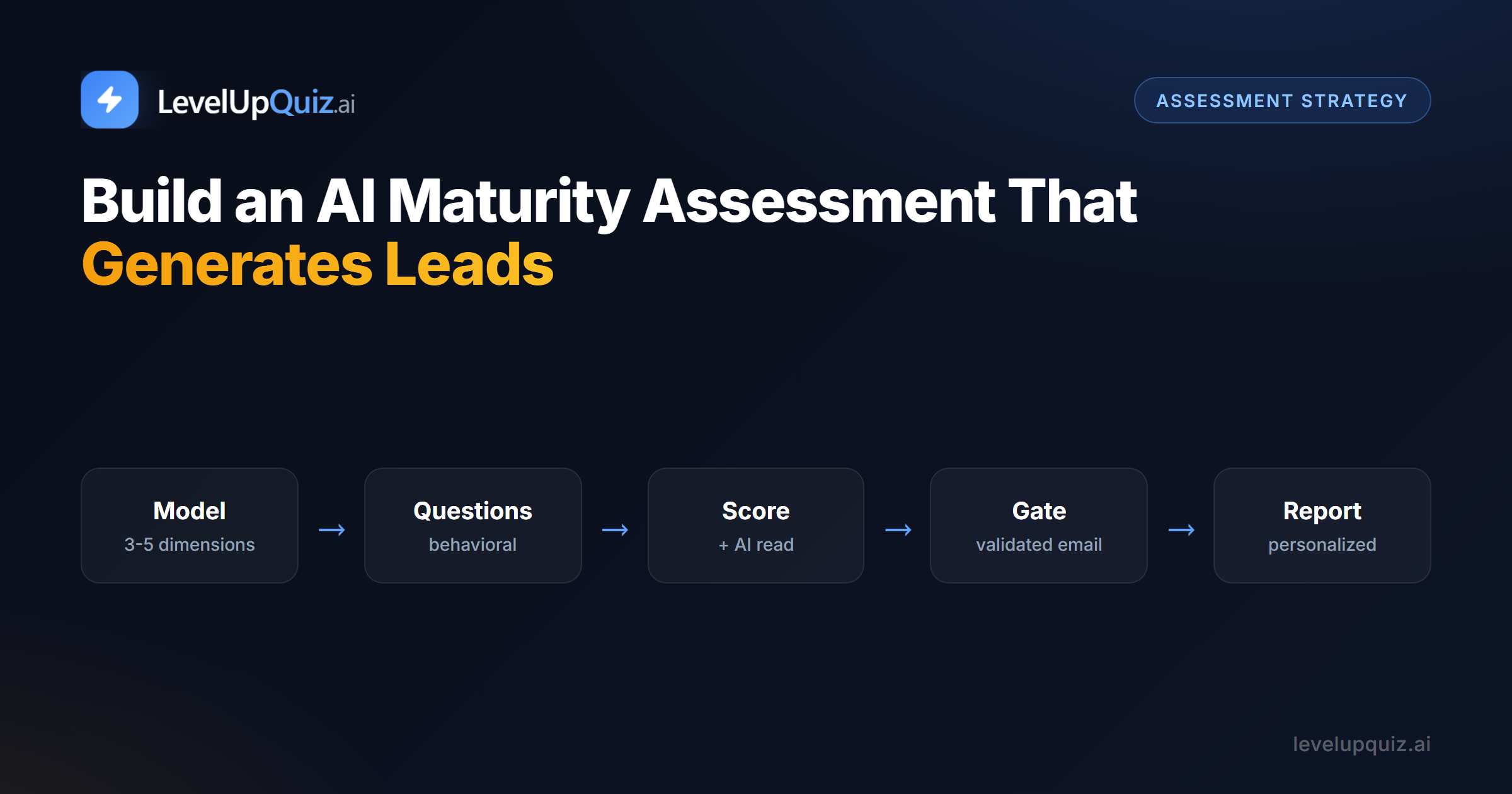
Key Takeaways
- A good assessment delivers a real diagnosis, not a thinly veiled lead form.
- Build it on a credible model with three to five distinct, observable dimensions.
- Show the score instantly; gate the full breakdown behind a validated business email.
- Every captured lead arrives pre-qualified by its own answers.
Most things called an "assessment" are lead forms wearing a costume: five vanity questions, a meaningless badge, and a hard gate in front of nothing. They convert badly because they give nothing in return. A real assessment delivers a genuine diagnosis, and earns the email as a byproduct. Here is how to build one, step by step.
Step 1: Start With a Credible Model
Your assessment is only as good as the framework underneath it. Before you write a single question, decide what you are actually measuring. The strongest models break a fuzzy outcome ("are we good at go-to-market?") into three to five concrete dimensions a respondent can be scored on independently, for example: data foundation, process maturity, automation, and decision-making.
Two rules for the model:
- Dimensions must be distinct. If two categories always move together, collapse them into one. Overlap inflates scores and muddies the diagnosis.
- Dimensions must be observable. You should be able to write a question whose answer places someone on that scale. "Strategic alignment" is hard to score; "we review pipeline against forecast every week" is not.
If you already have a methodology, a book, or a strong point of view, the model is usually hiding inside it. Pull out the things you tell every client to fix. Those are your dimensions. For a sales-led SaaS they might be data, pipeline process, and forecasting; for a consultant, strategy, execution, and measurement; for a marketing team, targeting, content, and attribution. Different businesses, same principle: three to five things you can score independently and actually act on.
Step 2: Define Your Maturity Levels
A score on its own ("62/100") means nothing. Levels give it meaning. Define three to five named levels and write a one-paragraph description of what a team at each level actually looks like, their habits, their tools, their blind spots.
Name them in your language, not generic "beginner/intermediate/advanced." Distinct, slightly aspirational names ("Manual", "Assisted", "Integrated", "Automated", "AI-Native") make the result feel like a diagnosis rather than a report card. The respondent should read their level and think, "that's uncomfortably accurate". That reaction is what makes them want the full breakdown.
Step 3: Write Questions That Diagnose
Each question should map to exactly one dimension and help place the respondent on its levels. Mix two types: Likert scales ("Strongly disagree → Strongly agree") for fast quantitative scoring. Your workhorse, and a few open-ended prompts for qualitative depth and, if you score with AI, for reading intent.
Write about behavior, not aspiration. People rate their intentions generously and their actions honestly, so anchor questions in observable reality. The same question, worst to best:
- Weak: "Rate your data maturity." (jargon, invites a flattering guess)
- Better: "How confident are you in your pipeline forecast?" (still a feeling)
- Best: "We can predict next quarter's revenue within 10%." (a concrete claim they either recognize as true or not)
Aim for 10-20 questions total, two to four per dimension, enough to score credibly without exhausting anyone.
Step 4: Build the Scoring Logic
Decide how answers become a score and a level. The simplest reliable approach: each Likert answer contributes points to its dimension; dimension scores roll up into an overall score; thresholds map that overall score to a level. Weight dimensions if some genuinely matter more, but keep the logic explainable, because you will defend it on sales calls.
This is also where AI scoring earns its place. Point-based logic gives you a band; AI scoring can additionally read the open-ended answers through your framework, map them to levels, and surface the specific gaps and intent signals a sum can't capture. Build the clear point-based logic first, then layer AI interpretation on top, not the other way around.
How AI Sharpens the Diagnosis
Point-based scoring gets you a defensible number. AI scoring is what turns that number into a diagnosis worth gating, and it does three things a sum can't.
First, it reads the open-ended answers. When a respondent types "we know we should use the data we collect but no one owns it," a Likert scale sees nothing; an AI model reading through your framework hears an ownership gap and an intent signal. Second, it maps the whole pattern of answers to a level and explains why, in your language, so the report reads like a consultant's note, not a calculator's output. Third, it does this identically for every respondent, applying your methodology consistently at a scale no human reviewer could match.
The order matters: build the transparent point logic first so you can always explain a score, then layer AI interpretation on top to add the nuance and the narrative. AI replaces the analyst's read, not the arithmetic.
Step 5: Deliver Value Before You Ask
This is the move that separates a lead-generating assessment from a lead-blocking one. The moment a respondent finishes, show them their raw score and level, instantly, ungated. That is the hook: proof that the full report is worth an email.
Then gate the depth, not the basics. The score is free; the category-by-category breakdown, the specific gaps, and the prioritized action plan sit behind a business-email gate. Because the respondent already received something useful, the trade feels fair instead of extractive. Validate the email, block consumer domains, verify the domain accepts mail, screen obvious fakes, so you capture real businesses, not "asdf@gmail.com."
Step 6: Make the Report Feel Personal
A generic report after an email gate is worse than no assessment at all: it burns the trust you just earned. The full result must read like it was written for this one respondent.
Lead with the verdict (their level and what it means), then the evidence (their scores by dimension), then the plan (the two or three things to fix first, in priority order). Reflect their gaps back in their own context, "your data foundation is strong, but decisions still rely on gut over the signals you already collect" lands far harder than a stock paragraph. Two people with the same overall score should still recognize themselves in two different reports.
Step 7: Qualify and Route on the Way In
Because the respondent told you about their situation to earn their score, every captured lead arrives pre-qualified. Use it. Pass the level and dimension scores to your CRM, route high-readiness respondents to a sales conversation and lower-readiness ones to a nurture track, and let your team open every call with the prospect's own result on screen. You are not just collecting emails. You are collecting context.
What You Need to Build One
An assessment sounds like a big project. The minimum viable version isn't:
- A model, three to five dimensions and three to five levels. You likely already have this in your methodology.
- 9-20 questions, two to four per dimension, behavioral, mostly Likert.
- Scoring logic, points per answer, rolled up to a level. Arithmetic, not machine learning.
- A gated result, instant score, then a personalized breakdown behind a validated email.
- A single destination, one channel pointed at one assessment, so you can actually read the results.
You do not need a huge content library, a data team, or a six-week build. You need a clear model and the discipline to gate depth instead of basics. Start narrow, ship it, and let what respondents actually answer tell you what to refine.
A Worked Example: A Three-Dimension Scorecard
Say you're a RevOps consultant. Your methodology says healthy go-to-market rests on three things: clean data, tight process, and smart automation. Those become your three dimensions.
For each, you define three levels, Reactive, Repeatable, Optimized, with a short description of each. Then you write three behavioral questions per dimension. For data: "We trust our CRM data enough to act on it without manual checking" (Likert). For process: "Every deal follows the same documented stages." For automation: "Routine follow-up happens without someone remembering to send it."
Scoring is simple arithmetic: each Likert answer is worth 0-4 points, each dimension maxes at 12, and the three roll up to a 36-point total mapped to an overall level. A respondent who scores high on data but low on automation lands at "Repeatable" overall, and, crucially, their report can say exactly that: strong foundation, untapped leverage. That specificity is what makes them want to talk to you.
Notice what you didn't need: a huge question bank or a clever algorithm. Nine good questions and three clear levels produce a credible, personal result.
What "Working" Looks Like
Judge the assessment by the right metric. Opt-in rate matters, but the real signal is downstream: are the conversations it produces better?
Watch three things in the first few weeks. Completion rate tells you whether the promise and length are right, if people abandon, your questions are too many or too abstract. Email quality (real companies vs. throwaways) tells you whether your gate and validation are doing their job. And the tenor of sales calls tells you whether the result is actually qualifying: reps should open with the prospect's own diagnosis on screen instead of starting discovery from zero.
If completion is high, emails are real, and calls start warmer, you've built something that compounds. If not, the fix is almost always upstream, a vaguer-than-you-thought promise, too many questions, or a result that doesn't feel personal. Fix those before you touch traffic.
Common Mistakes to Avoid
- Gating the score. Asking for the email before showing any value is the pattern people resent. Give the score; gate the depth.
- Too many questions. Length should match the value of the result. Twenty questions for a one-line verdict is a bad trade, and respondents price it instantly.
- A vanity result. If everyone gets roughly the same flattering report, you have a quiz, not a diagnostic, and it won't generate trust or leads.
- A model you can't defend. If a prospect could poke holes in your dimensions on a call, fix the model before you launch.
Putting It Live
Start with one assessment, built around the single question your best customers wrestle with. Get the model, levels, questions, scoring, and result right before you worry about traffic. Then point your warmest channel at it and judge it by the quality of the conversations it produces, not just the opt-in rate. A well-built assessment doesn't only capture leads. It makes every downstream conversation easier.
Frequently Asked Questions
Related Articles
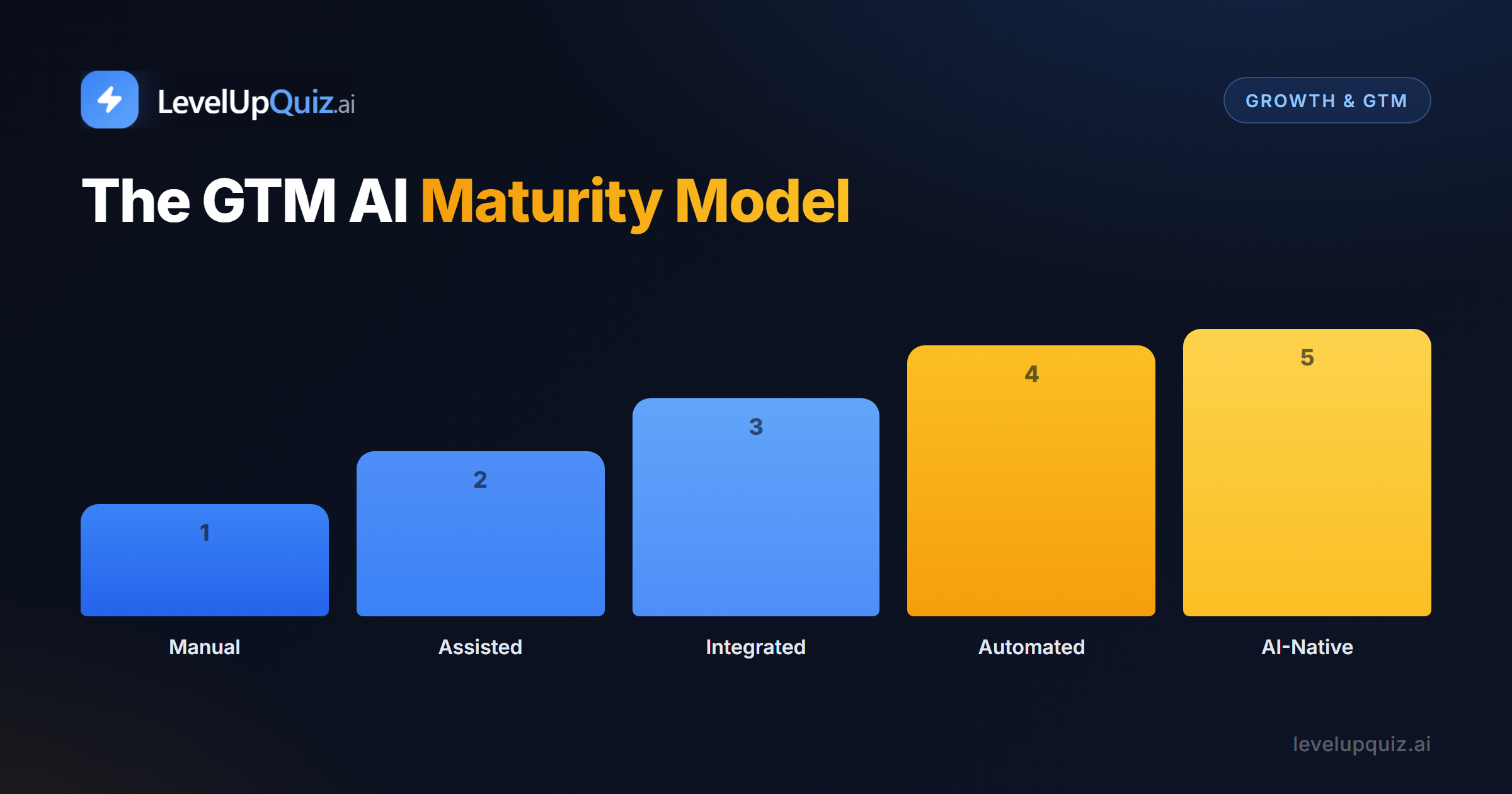
The GTM AI Maturity Model, Explained
A five-stage model for go-to-market AI maturity, from manual processes to an AI-native growth engine, and how to find your stage.
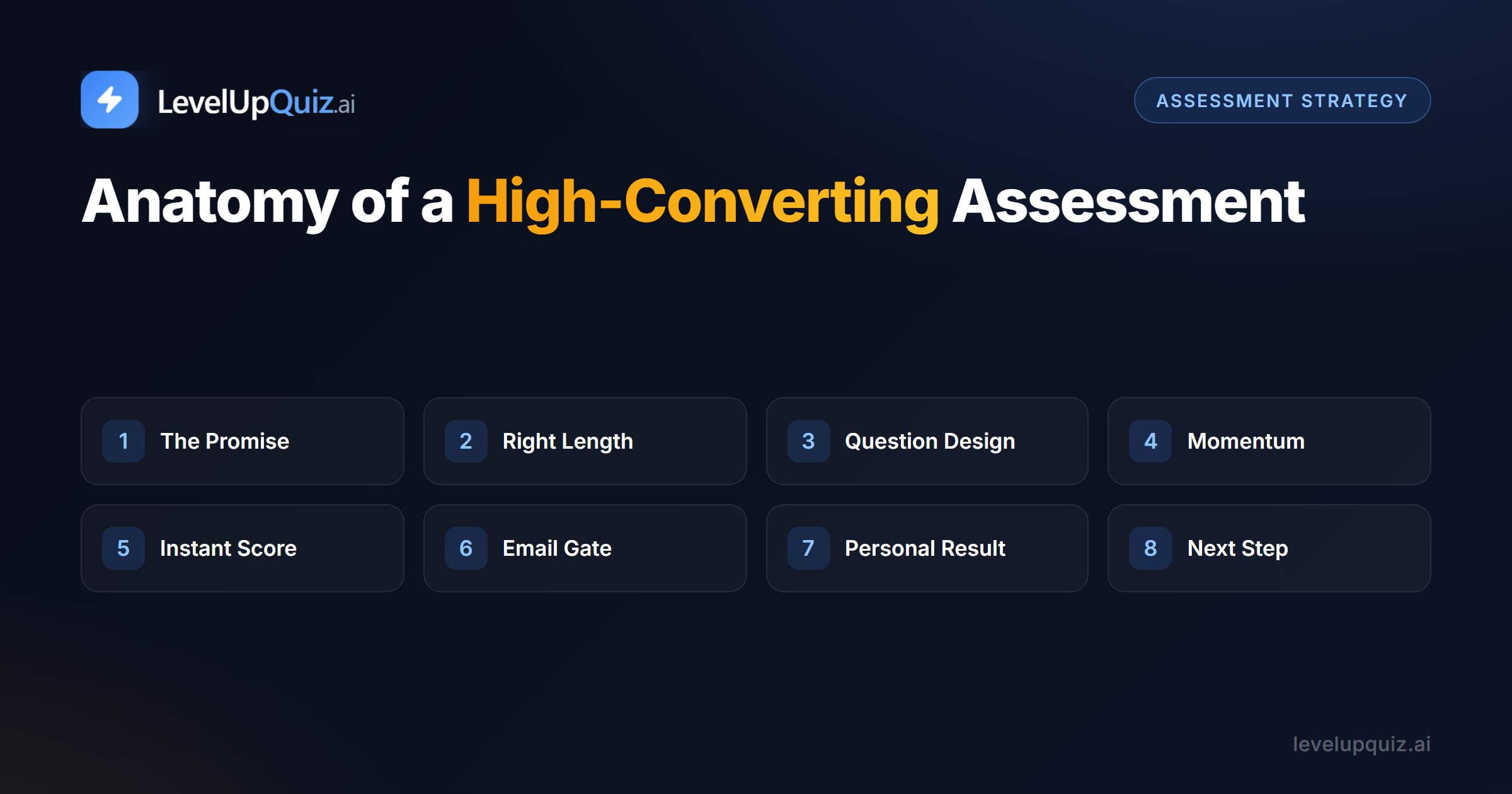
The Anatomy of a High-Converting B2B Assessment
The eight components that separate an assessment people finish and share from one they abandon on question three, from the promise to the personalized result.