The GTM AI Maturity Model, Explained
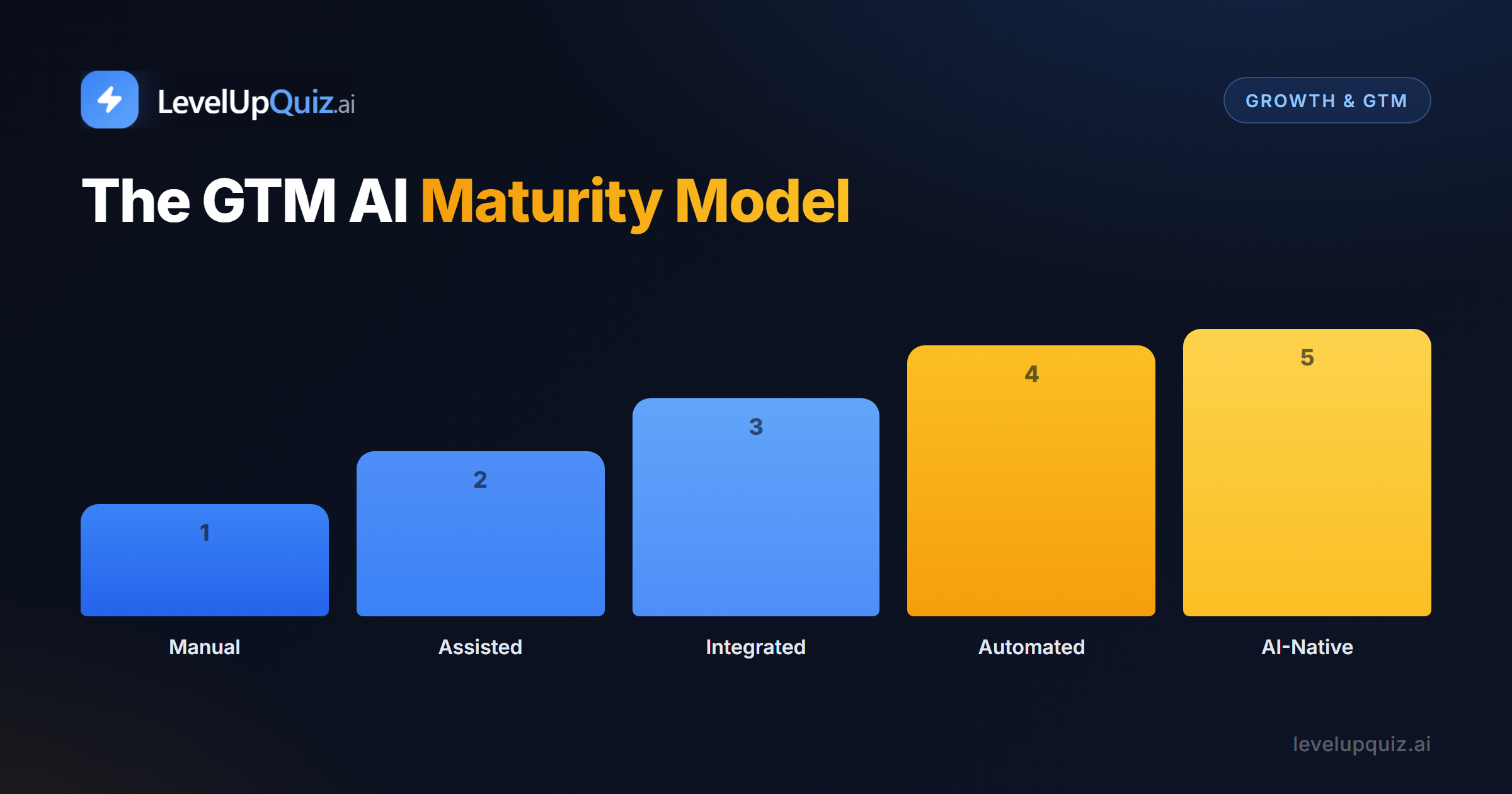
Five stages from manual go-to-market to an AI-native growth engine.
Key Takeaways
- Maturity is a progression, not a switch, most teams are mid-journey.
- Each stage unlocks the next; skipping stages creates fragile automation.
- Diagnosing your stage honestly is the first step to a credible roadmap.
- Moving up means strengthening foundations, data first, before adding automation.
AI maturity in go-to-market isn't binary. You don't flip a switch and become "an AI company." It's a progression, and most teams are somewhere in the middle, doing a few things well and many things by hand. This model describes the five stages, what defines each, and, more usefully, how to tell which one you're actually in and how to move up without building on sand.
Why Maturity Is a Progression, Not a Switch
The temptation is to buy a tool and declare victory. But AI maturity is less about tools than about foundations: the quality of your data, how connected your systems are, and how much you trust AI to inform real decisions. Each stage builds the base the next one stands on. Skip a stage and you get fragile automation, fast, confident, and wrong. The point of a maturity model isn't to rank you; it's to show you the next foundation to lay.
Stage 1: Manual
Spreadsheets, gut calls, and disconnected tools. AI is absent or, at most, someone is pasting things into a chatbot on the side. Decisions rely on whoever has the strongest opinion in the room, and the same analysis gets rebuilt by hand every week.
This stage isn't a failure, plenty of good businesses run here. But it doesn't scale, and the work that feels productive (manual reporting, repetitive outreach) is exactly what later stages automate away.
Stage 2: Assisted
Point solutions start helping: an AI writing assistant for copy, a scoring tool for leads, an enrichment service for contact data. The wins are real but isolated, each tool lives in its own silo, and nothing talks to anything else.
The trap here is mistaking activity for maturity. Ten disconnected AI tools is still Stage 2. The unlock to the next stage is connection, not more point solutions.
Stage 3: Integrated
Data flows between systems, and AI starts informing real decisions across the funnel rather than in isolated pockets. Your CRM, your assessment or lead-capture data, and your enrichment all feed a shared picture, and AI uses that whole picture, not one slice, to score, route, and recommend.
This is the stage where the foundation finally pays off: because the data is connected and trusted, the outputs are good enough to act on without double-checking everything by hand.
Stage 4: Automated
Workflows run end to end with humans in the loop for judgment. AI handles routine execution, qualifying, routing, drafting, follow-up, and people spend their time on exceptions and relationships. The system does the repetitive work reliably; humans own the calls that need judgment.
The risk at this stage is over-automating before the data is trustworthy. Automation amplifies whatever it's built on, so Stage 4 only works because Stages 1-3 made the foundation solid.
Stage 5: AI-Native
Growth is designed around AI capabilities from the start rather than bolted onto a traditional motion. The org compounds: every interaction generates data, the data improves the models, and the better models improve the next interaction. AI isn't a tool the team uses. It's how the team operates.
Few organizations are genuinely here, and that's fine. Stage 5 is a direction, not a finish line.
What Each Stage Unlocks
It helps to see the progression as a chain of unlocks, each making the next stage possible:
- Manual → Assisted: the first AI tools remove the most painful manual work and prove the value, building appetite for more.
- Assisted → Integrated: connecting your tools and data turns isolated wins into a shared, trusted picture, the precondition for AI making good cross-funnel decisions.
- Integrated → Automated: because the data is now trustworthy, you can safely hand routine execution to AI with humans on the exceptions.
- Automated → AI-Native: with execution automated and data compounding, you can redesign the whole motion around AI from the ground up.
Read top to bottom, the pattern is obvious: every unlock depends on the foundation below it. That's why the order matters, and why skipping a link breaks the chain.
A Worked Example: The Stage 2 Plateau
Picture a mid-market team that's proud of its stack. There's an AI SDR tool, an AI copywriter, a lead-scoring add-on, and an enrichment service. On paper it looks advanced. In practice it's stuck at Stage 2: and the symptoms are textbook.
Each tool works in its own silo. The scoring model never sees the enrichment data; the SDR tool doesn't know what the website assessment captured; reporting is still stitched together by hand in a spreadsheet every Monday. Leadership keeps buying tools expecting a jump in maturity, but maturity doesn't come from more point solutions. It comes from connecting the ones you already have.
The fix isn't another purchase; it's integration. Pipe the assessment and enrichment data into one place, let the scoring model use all of it, and the same tools start compounding instead of operating blind. That single move, Stage 2 to Stage 3: usually unlocks more value than the last three tools combined.
How Maturity Shows Up in Your Numbers
You can often spot a team's stage from its metrics and its meetings, without an assessment at all.
Manual and Assisted teams spend their weekly review building the report, pulling numbers by hand, reconciling tools that disagree. Forecasts are gut calls dressed up in a spreadsheet, and "why did we win or lose that deal?" earns an anecdote, not an answer. Integrated teams open the same meeting with a shared dashboard everyone trusts, so the conversation is about decisions rather than data wrangling. Automated teams notice that routine work, follow-ups, routing, qualification, simply happens, freeing the meeting for exceptions and strategy. AI-native teams find the system surfaces the questions before anyone thinks to ask them.
The tell is simple: if your team spends more time assembling the truth than acting on it, you're earlier in the model than your tool count suggests, and the fix is foundation, not features.
How to Diagnose Your Stage
Don't guess, score yourself honestly on three dimensions:
- Data foundation. Is your data clean, connected, and trusted, or scattered across tools no one fully believes?
- Automation coverage. Which workflows actually run without manual effort, and which just feel automated because a tool is involved?
- Decision-making. Is AI an experiment, an input, or the default for real decisions?
Your lowest dimension usually sets your true stage, because the foundation gates everything above it. A team with brilliant automation on untrusted data is not Stage 4: it's a Stage 2 data problem wearing a Stage 4 costume.
How to Move Up a Stage
Moving up is mostly unglamorous foundation work, not shopping:
- Fix the lowest dimension first. If data is your weak point, connecting and cleaning it unlocks more than any new tool.
- Connect before you automate. Integration (Stage 3) is the prerequisite for safe automation (Stage 4). Automating on disconnected data just makes mistakes faster.
- Earn trust incrementally. Let AI inform decisions before it makes them. Confidence to automate comes from watching it get the recommendations right.
Each step is a quarter's worth of work, not a week's, which is exactly why teams stall, and why honest diagnosis matters more than ambition.
A Roadmap You Can Actually Follow
Knowing your stage is useless without a sequence to act on. The good news: the sequence is the same wherever you start, strengthen the weakest foundation before adding anything on top.
If you're at Stage 1 or 2, spend the first quarter getting one source of truth, usually the CRM, clean and connected, and wire your highest-value data (assessment results, enrichment, product usage) into it. Resist buying more point tools; you don't have a tools problem, you have a connection problem. At Stage 3, shift the work to trust: let AI inform a few real decisions, lead scoring, prioritization, and check whether it gets them right before you let it act unattended. Only once you trust the outputs do you automate execution (Stage 4), and only once execution runs reliably do you redesign the motion around AI (Stage 5).
Each step is a quarter of unglamorous foundation work, not a week of shopping. Mapped out, it's rarely more than a year from "spreadsheets and gut calls" to genuinely integrated, but only if you do the stages in order.
Why This Matters for Lead Generation
The maturity model isn't only a self-assessment exercise. It's a lens on how you generate and qualify demand. Lower-maturity teams treat every lead the same because they have no connected data to tell them apart. Higher-maturity teams route and prioritize automatically, because integration and trustworthy scoring make it possible.
It's also why a maturity model makes such effective lead-generation content. The thing every team quietly wants to know is "where do we actually stand?" Turn the model into a scored assessment and you give prospects that answer instantly, while learning their stage, their gaps, and their readiness to buy. The diagnosis qualifies the lead as a byproduct, and the first conversation starts with their situation instead of your pitch. The model that describes the destination doubles as the funnel that fills your pipeline.
The Cost of Standing Still
Maturity isn't a vanity ranking, the gap between stages compounds. A team whose data is connected and whose scoring is trusted makes faster, better decisions every week, and that advantage accrues. A team stuck assembling spreadsheets pays the same tax over and over, and falls further behind the teams that automated it away.
That's why "we'll get to it" is more expensive than it sounds. Every quarter at a lower stage is a quarter of slower decisions, wasted rep hours, and leads worked in the wrong order. You don't have to leap to AI-native, but standing still while competitors lay foundations is itself a choice, and it has a cost.
Where Teams Get Stuck
The most common stall is the Stage 2 plateau: a pile of disconnected point tools that feels modern but never compounds, because nothing is integrated. The second is over-reaching, jumping at Stage 4 automation on a Stage 2 data foundation, then quietly turning it off when it produces confident nonsense. Diagnose honestly, fix the foundation under you, and build the roadmap one stage at a time.
Frequently Asked Questions
Related Articles
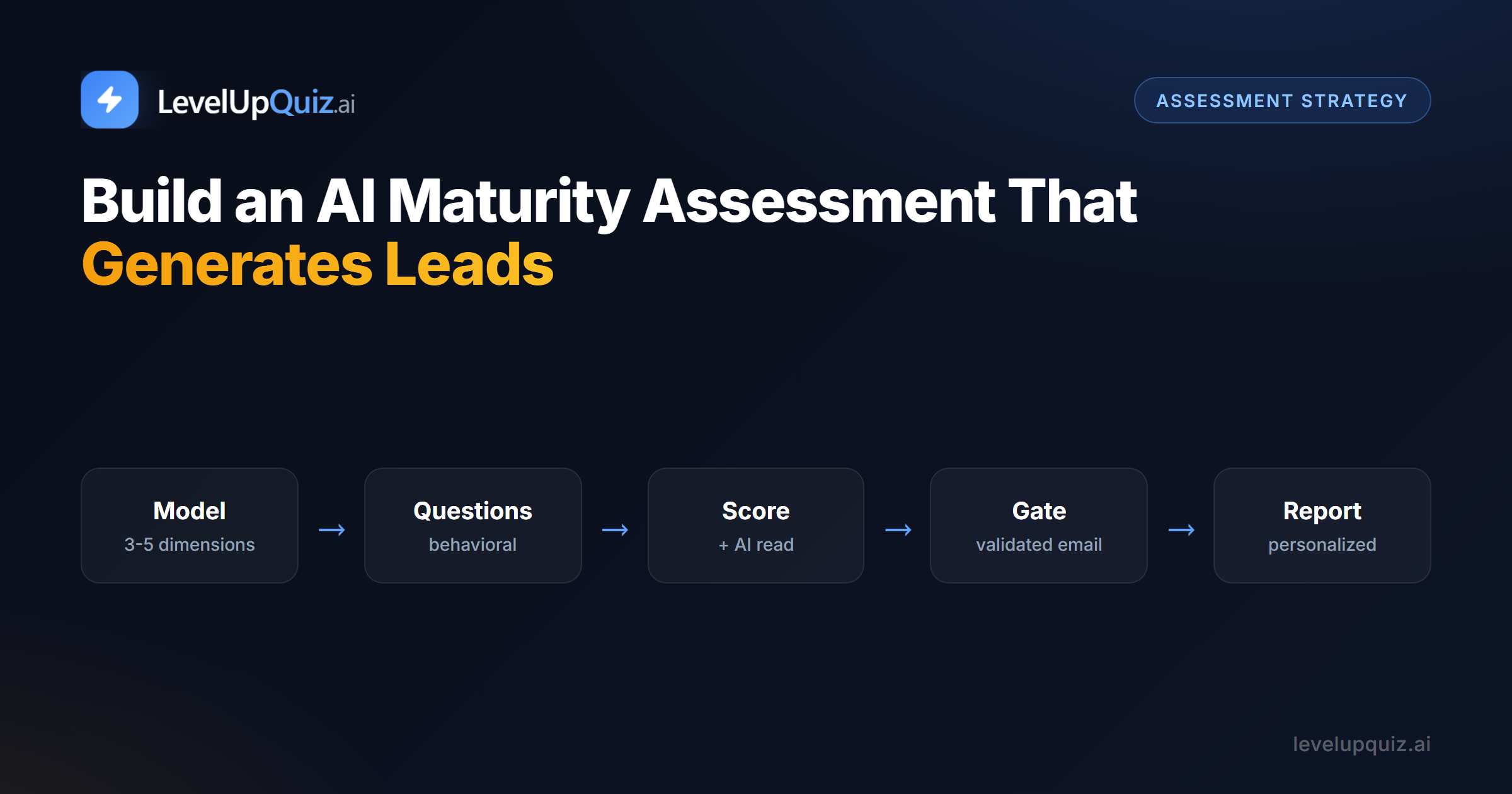
How to Build an AI Maturity Assessment That Actually Generates Leads
A step-by-step guide to turning your framework into a scored AI maturity assessment that delivers value and captures validated B2B leads.
"Book a Demo" Is Dead: The Rise of Self-Qualifying Funnels
Buyers want to diagnose themselves before they talk to sales. Assessment-led, self-qualifying funnels meet them there, and hand sales a warmer, smarter lead.
Assessment-Led Marketing in Practice: What Actually Changes
Put a scored assessment at the front of your funnel and the metric that matters flips from lead volume to lead quality. The honest breakdown, including where it falls short.