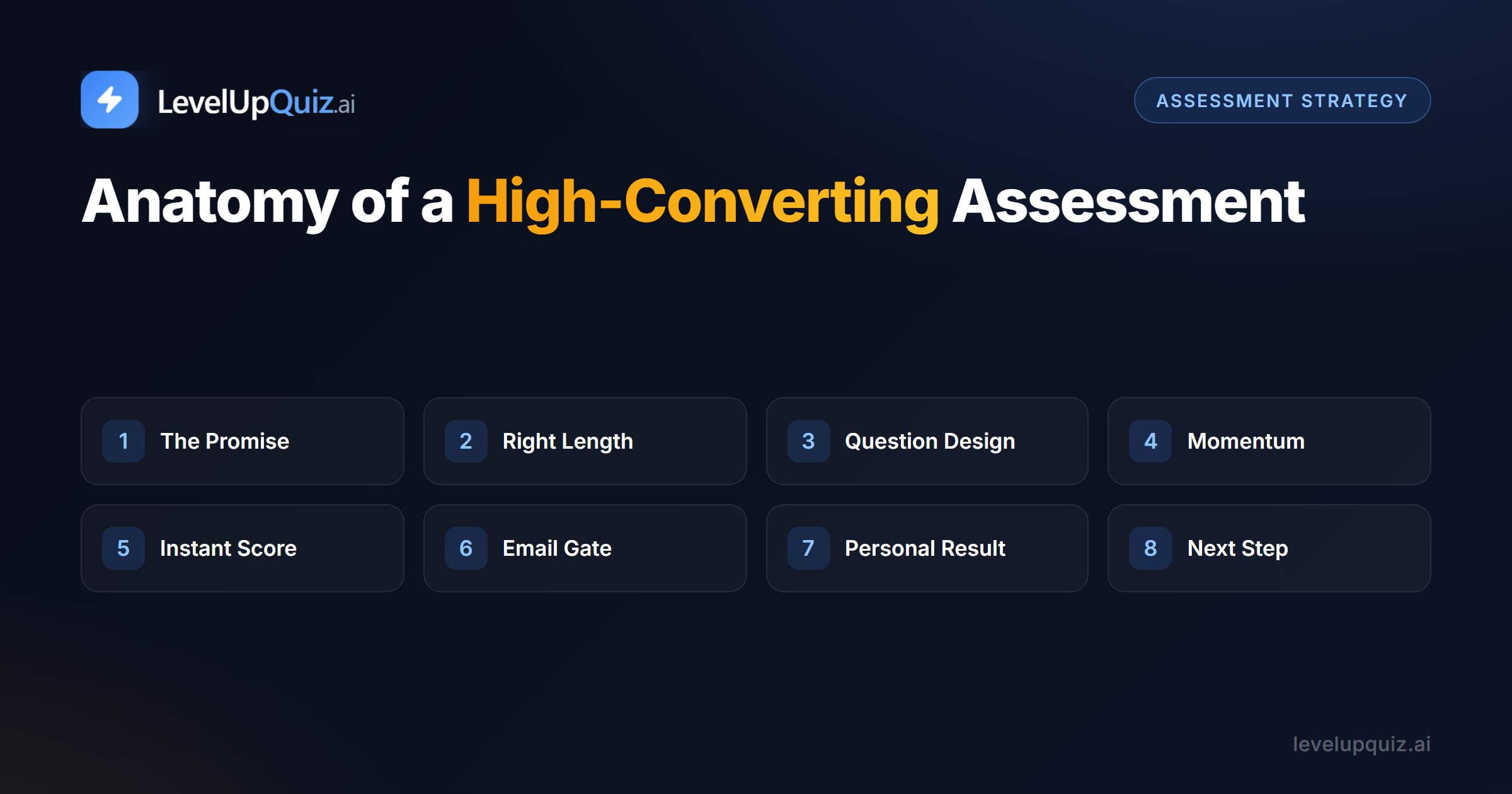
The Anatomy of a High-Converting B2B Assessment
Eight components that decide whether a prospect finishes, converts, and shares, and how to engineer each one.
Key Takeaways
- A specific, comparative promise sets your completion rate before the first question.
- Length should be governed by the value of the result, not an arbitrary question count.
- Show the raw score instantly; gate the full breakdown behind a validated business email.
- The result must feel written for one person, their level, their gaps, their next step.
Most B2B assessments are lead forms in a costume. They ask a few questions, drop the visitor into a generic bucket, and demand an email before delivering anything worth having. They convert poorly because they were never engineered to convert. They were bolted together.
A high-converting assessment is different. It is designed, component by component, around a single idea: deliver real value as the experience, and the email becomes a fair trade rather than a toll.
The distinction is not cosmetic. A form interrupts; an assessment engages. A form extracts; an assessment gives first. Get the eight components below right and you stop fighting your prospect for an email and start having them volunteer it.
1. The Promise
Everything starts with the promise, because the promise sets your completion rate before anyone answers a question. A vague invitation, "Take our quiz!", earns vague engagement. A specific, comparative promise, "See how your go-to-market maturity stacks up against the AI-native benchmark", earns intent.
A strong promise does three things. It names a specific outcome the reader wants ("find out where you are"), it implies a comparison ("against the benchmark," "versus your peers"), and it hints at a payoff worth working for ("a prioritized plan to close the gaps"). Notice that none of that is about you. It is about the reader's curiosity regarding themselves.
The promise lives in the title, the landing copy, and the first screen of the assessment itself. Keep all three consistent. If the landing page promises a maturity diagnosis and the first question asks about budget, you have broken the contract and the abandon rate will show it. Write the promise first, then build backward into the questions that can actually deliver it.
A quick gut check: read your title aloud and ask whether a busy buyer would trade two minutes of attention to learn the answer about themselves. "Is your sales process efficient?" fails. It's abstract and self-evidently leading. "Where is your pipeline leaking revenue, and how do you compare to teams that have fixed it?" works, because it promises something specific, personal, and comparative all at once.
2. The Right Length
The most common length mistake is choosing a number of questions arbitrarily, "let's do ten", instead of deriving it from the value of the result. Length should be governed by the depth of the output you intend to deliver.
If you promise a quick gut-check, three to five questions is honest, and gating a heavyweight report behind it is not. If you promise a genuine diagnosis with a category-by-category breakdown, you need enough questions to score each category credibly, typically two to four per dimension, across three to five dimensions. That lands most serious B2B assessments in the 10-20 question range.
The test is simple: every question must earn its place by contributing to the result. If you cannot point to how an answer changes the score or the report, cut it. Respondents can feel padding, and each unnecessary question raises the abandon risk without improving the diagnosis. Long is fine when long is justified; long for its own sake is where assessments go to die.
A useful rule of thumb: the assessment should take about as long as its result deserves attention. If the payoff is a five-minute read, asking for five minutes of input is a fair exchange. Asking for fifteen to deliver the same five-minute payoff is not, and respondents price that imbalance instantly.
3. Question Design That Scores
Good questions do double duty: they feel natural to answer and they map cleanly to your scoring model. Before writing a single question, define the dimensions you are measuring and what each maturity level means within them. The questions then become the instrument that places someone on those scales.
Mix question types deliberately. Likert scales ("Strongly disagree → Strongly agree") are the workhorse of quantitative scoring, fast to answer and easy to weight. A small number of open-ended prompts add qualitative depth and, when analyzed well, surface intent and nuance a number never could. One or two open responses per assessment is usually enough; more and you tax the respondent.
Write each question in the reader's language, not your framework's jargon. Phrase items so that the answer reveals behavior, not aspiration. People rate their intentions generously and their actions honestly; design for the latter.
Here is the same question written three ways, worst to best:
- Weak: "Rate your data maturity." (jargon, abstract, invites a flattering guess)
- Better: "How confident are you in your pipeline forecast?" (behavioral, but still a feeling)
- Best: "We can predict next quarter's revenue within 10%." (a concrete claim they either recognize as true or not)
The best version scores cleanly and forces honest reflection, because it describes an observable reality rather than a self-image.
4. Momentum and Progress
Completion is largely a psychology problem, and the psychology is about perceived remaining effort. People finish what they can see the end of. So show the end.
A visible progress indicator, a bar, "Question 4 of 12," or named sections the reader moves through, reframes the experience from open-ended chore to bounded task. Grouping questions into labeled categories ("Data Foundation," "Automation," "Decision-Making") does double work: it structures the scoring and it gives the respondent a sense of moving through a thoughtful, finite journey rather than an endless form.
Keep each screen light. One idea per question, generous tap targets on mobile, and no dead ends. Every extra second of friction is a chance to abandon. The goal is a rhythm, answer, advance, answer, advance. That carries momentum straight into the moment that matters most: the reveal.
5. The Instant Score
The instant score is the hook, and it is the component teams most often get wrong by hiding it. The moment a respondent finishes, show them something real, a number, a level, a one-line verdict, immediately and ungated.
This works because it pays off the promise and creates a curiosity gap in the same instant. "You scored 62/100, Level 3: The Integrator" answers the question they came to ask and raises three new ones: What does Level 3 mean? Where did I lose points? How do I get to Level 4? That gap is exactly what makes the next step, the email, feel worth it.
Resist the temptation to gate the score itself. Gating the score asks for payment before delivering any value, which is the very pattern that makes people resent forms. Give the "what" freely. You will charge an email for the "so what" and the "now what," and because the respondent already values the score, the trade reads as fair rather than extractive.
One practical refinement: pair the score with a single sentence of interpretation, not a wall of analysis. "Level 3 means your foundations are solid but your execution is inconsistent" is enough to make the full report irresistible without giving it away. You are opening a loop, not closing it.
6. The Email Gate
The gate is where most of the lead-generation value is captured, so it deserves precision. Gate the depth, not the basics. The raw score is free; the category-by-category breakdown, the specific gaps, and the prioritized action plan are what sit behind the email.
Frame the gate as an unlock, not a wall: "Enter your work email to see your full breakdown and your personalized plan." The copy should reference the value waiting on the other side, not the act of giving up an address. You are reminding them what they get, not what they pay.
Validate the email at the gate. Three layers do most of the work: block free consumer domains where they do not belong, verify that the domain actually accepts mail (MX records), and screen for obvious fakes. Validation is not about friction for its own sake. It is what keeps your CRM full of real businesses instead of "asdf@gmail.com," which is the difference between a lead list sales trusts and one they ignore.
Keep the gate itself minimal, a work email is usually enough. Every extra field (phone, company size, role) trades conversion for data you can often enrich later or infer from the answers themselves. Ask for the one thing you truly need now, and let the assessment supply the rest.
7. The Personalized Result
Here is where assessments earn their reputation, or squander it. The full result must feel like it was written for one specific person, because a generic report after an email gate is the bait-and-switch people remember.
Personalization comes from the answers. Name the maturity level and explain what it means for someone like them. Reflect their specific gaps back in their own context, "Your data foundation is strong, but decision-making still relies on gut over the signals you are already collecting" lands far harder than a stock paragraph. Then give a prioritized next step or two, not a generic checklist of everything.
This is where AI scoring changes the economics. Mapping Likert answers to maturity levels and interpreting open-ended responses through your framework lets you produce a genuinely individual diagnosis for every respondent, in your terminology, applying your methodology, at a scale no human reviewer could match.
The format matters as much as the content. Lead with the verdict, then the evidence, then the plan, the same order a good consultant uses. Avoid the temptation to dump every data point; a focused report that names the two gaps that matter most will be read and acted on, while a comprehensive one gets skimmed and forgotten. The result should read like a short, sharp consult, not a templated PDF. When two people with the same total score still see themselves in two different reports, you have built it right.
8. The Next Step
The result earned attention. The final component spends it. End every report with one clear, relevant action, book a call, start a trial, read the playbook that addresses their biggest gap. One action, not a menu; choice here dilutes momentum just as it does in the questions.
Match the ask to the score. A high-maturity respondent might be ready for a conversation about advanced tactics; a low-maturity one is better served by a resource that builds confidence first. Routing the next step by result is not just good UX. It is the first act of qualification, and it hands your sales team a warm lead who already knows where they stand.
Putting It Together
These eight components are a chain, and a chain fails at its weakest link. A brilliant promise with a generic result still disappoints. A perfect result behind a broken gate never gets seen. The teams that win treat the assessment as a designed experience end to end: a promise that attracts the right people, a length that respects them, questions that score cleanly, momentum that carries them to a real score, a gate that trades fairly, a result that feels personal, and a next step that converts the attention they just earned.
Get the promise and the personalized result right first. They are the highest-leverage links, and let the rest compound from there.
Frequently Asked Questions
Related Articles
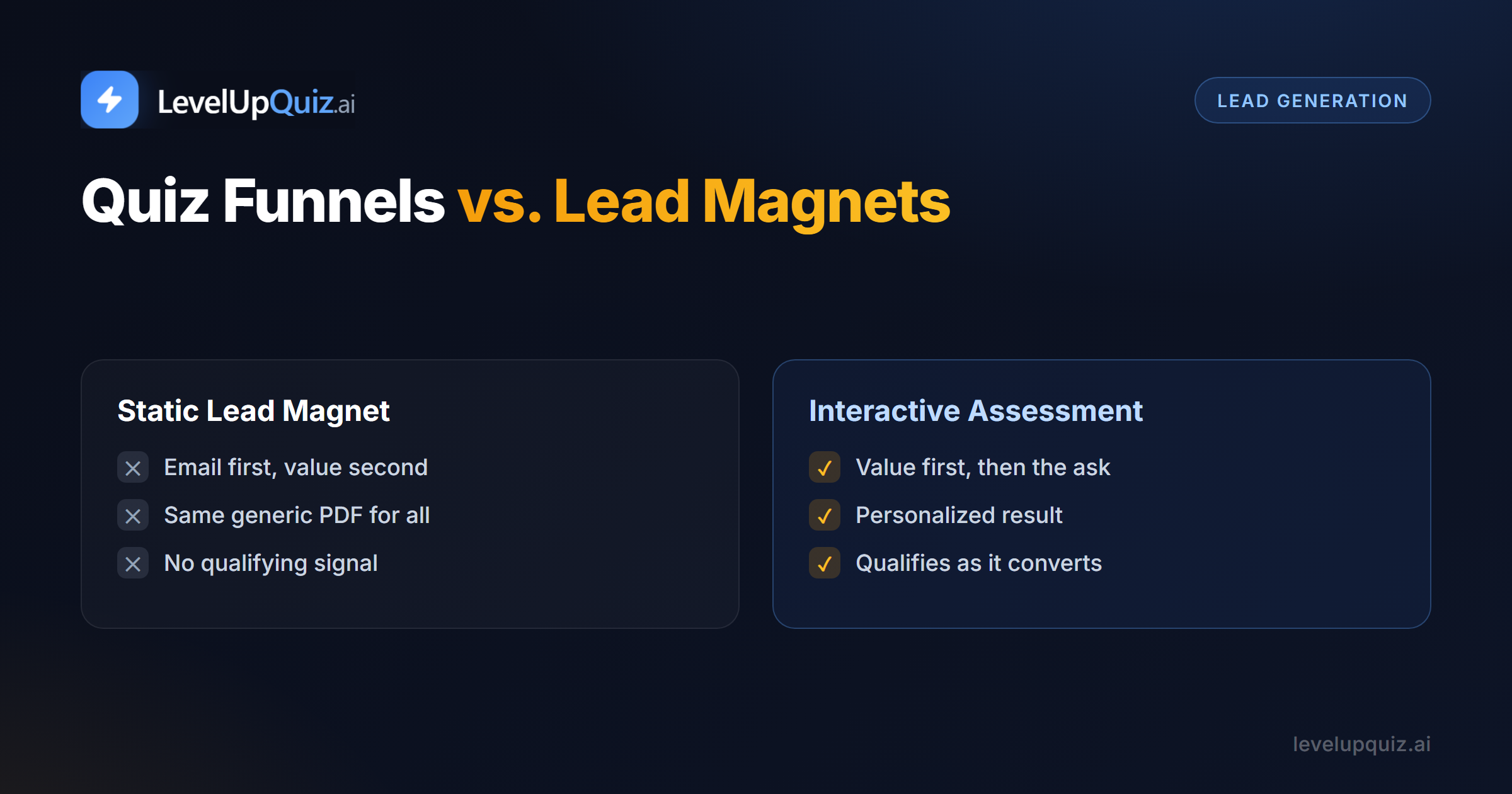
Quiz Funnels vs. Lead Magnets: Why Assessments Convert Better
Static lead magnets ask for the email before giving value. Assessments flip that, delivering a personalized result that earns the opt-in. Here is the breakdown.
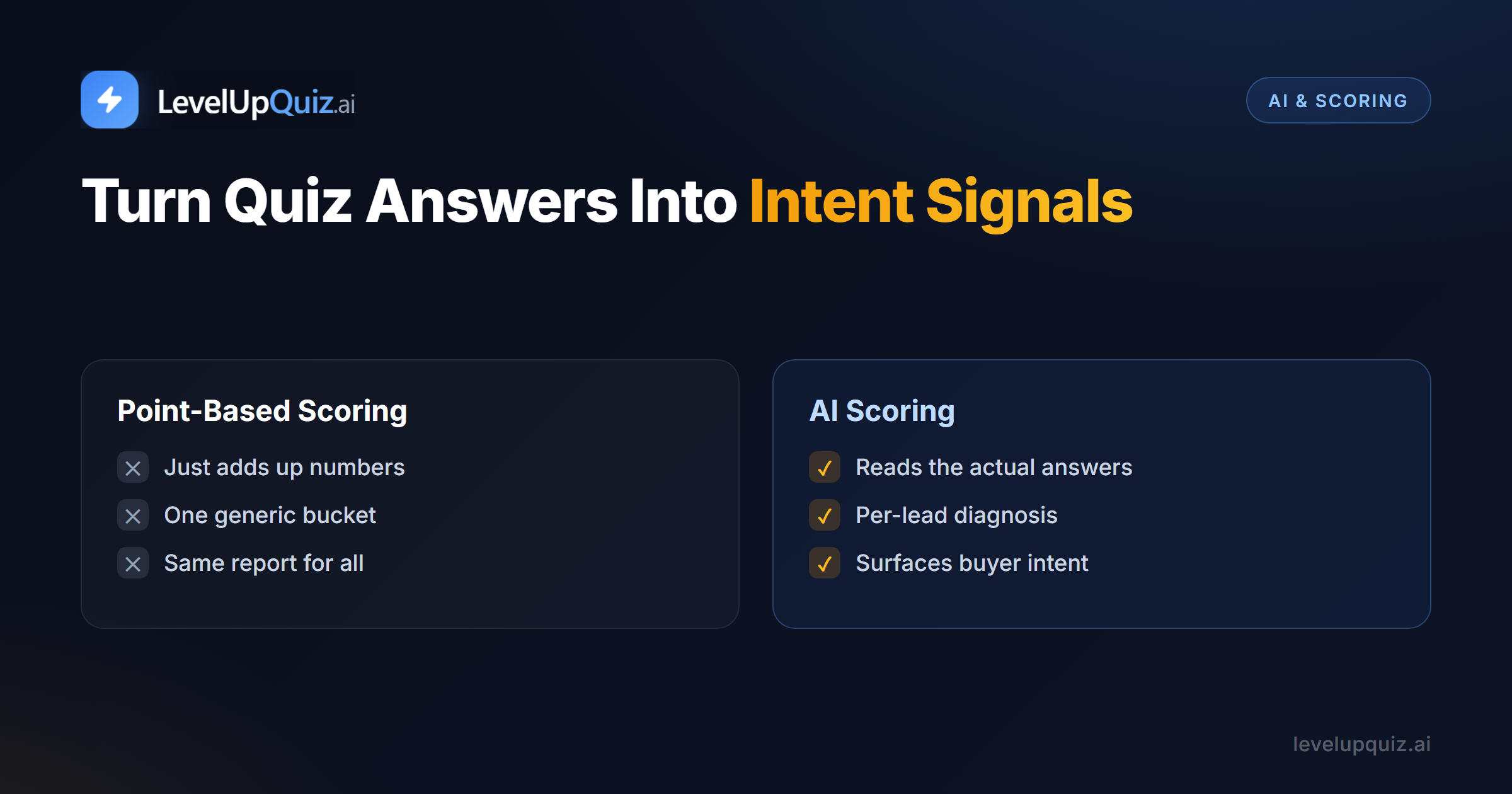
How AI Scoring Turns Quiz Answers Into Buyer-Intent Signals
Beyond adding up points: how AI reads open-ended quiz responses through your framework to surface intent, urgency, and fit, and produce a per-lead diagnosis.
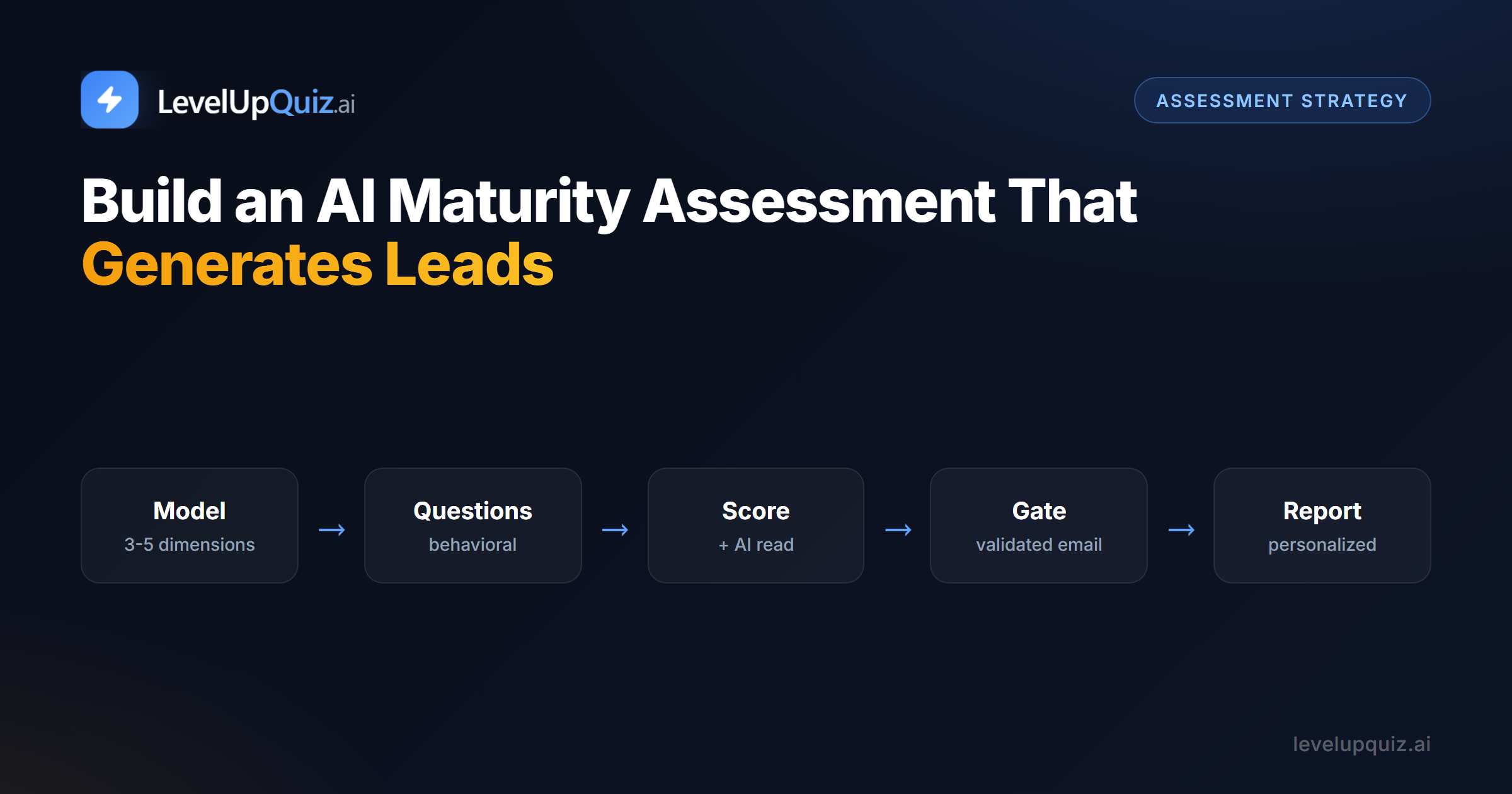
How to Build an AI Maturity Assessment That Actually Generates Leads
A step-by-step guide to turning your framework into a scored AI maturity assessment that delivers value and captures validated B2B leads.