How AI Scoring Turns Quiz Answers Into Buyer-Intent Signals
Beyond adding up points: how AI reads open-ended responses through your framework to surface intent, urgency, and fit.
Key Takeaways
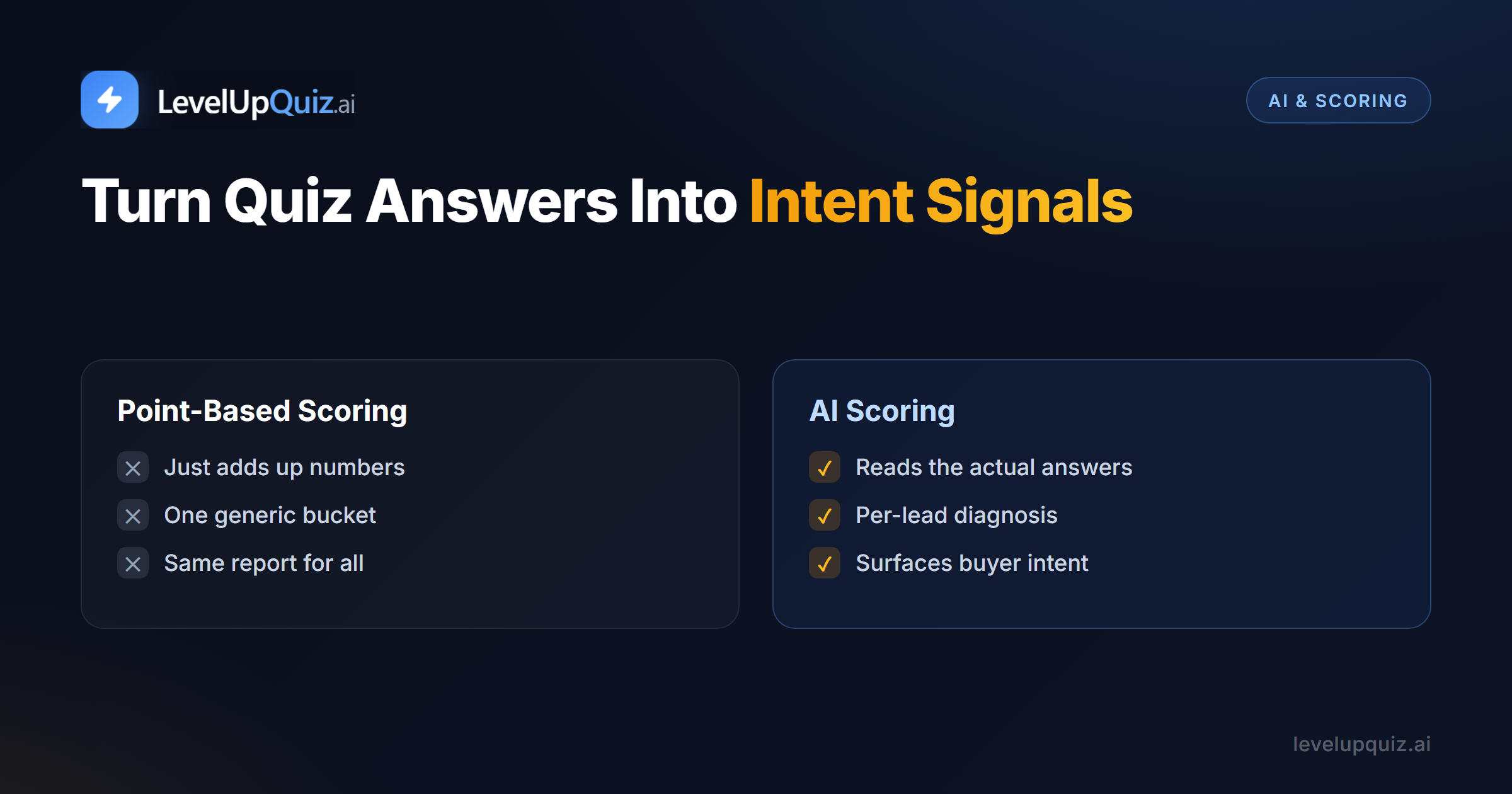
- Traditional scoring sums points; AI scoring interprets meaning.
- AI maps Likert scores to maturity levels and reads open text for nuance.
- The output is a per-lead diagnosis, not a one-size-fits-all band.
- Intent and urgency signals from answers help sales prioritize.
Most quizzes add up points and drop you in a bucket. That's fine for a magazine personality test; it's thin for a B2B assessment meant to qualify a lead. AI scoring does something different. It interprets what the answers mean and turns them into signals your sales team can actually act on. Here's how it works, and how to build it without sacrificing trust.
The Limits of Point-Based Scoring
Summing numeric answers gives you a band, and a band is useful. It's fast, transparent, and easy to explain. But it flattens nuance. Two respondents can land on the same 62/100 for completely different reasons: one strong on strategy but weak on execution, the other the exact reverse. Point-based scoring sees them as identical. Their reports shouldn't be.
It also ignores everything that isn't a number. The richest signal in most assessments lives in the open-ended answers, and a sum can't read a sentence.
What AI Scoring Adds
AI scoring layers interpretation on top of the math. It doesn't replace the points; it reads everything around them:
- Maps the pattern to a level in your framework, not just a number, and explains why.
- Reads open-ended responses for context, nuance, and the things a scale can't capture.
- Identifies the specific gaps holding each respondent back, in priority order.
The output shifts from "you scored 62" to "you're a Level 3 whose foundations are solid but whose execution is inconsistent. Here's the one gap to close first." That's a diagnosis, not a grade.
Reading Open-Ended Responses
The free-text answers are where intent hides. When a respondent types "we know we should act on our data but no one owns it," a Likert scale sees nothing. An AI model reading through your framework hears three things at once: a capability gap (data activation), an organizational gap (ownership), and an intent signal (they're aware and frustrated, often a buying trigger).
That reading is what turns an assessment from a scoring exercise into an intelligence-gathering one. The prospect tells you, in their own words, where they hurt, and the AI translates it into your framework's terms and your sales team's priorities.
A Worked Example: Two Identical Scores, Two Different Reports
Two respondents both score 62/100 on a go-to-market assessment.
Respondent A's answers and open text reveal strong data and process but weak forecasting, plus a note that "the board keeps asking for predictability we can't deliver." Respondent B's reveal the opposite, sharp forecasting, but messy data and "we're drowning in tools that don't talk."
Point-based scoring hands them the same report. AI scoring hands A a report centered on forecasting (and flags board pressure as urgency), and B a report centered on integration (and flags tool sprawl). Same number, two genuinely different diagnoses, and two different, relevant sales conversations.
Surfacing Buyer Intent
Beyond the diagnosis, AI scoring can surface the signals that tell sales who to call first. Language about urgency ("we need this fixed this quarter"), budget ("we've allocated for it"), current pain, and explicit goals all show up in open responses. Combined with the structured score, they form a readiness signal a raw number never could.
The payoff is prioritization: who's ready now, who's exploring, and what to lead with on the call. Your team spends its hours on the prospects most likely to move, instead of working a flat list top to bottom.
How to Build It Without Losing Trust
The order matters. Build transparent point-based logic first, so you can always explain how a score was reached, then layer AI interpretation on top to add the nuance and the narrative. AI replaces the analyst's read, not the arithmetic.
This sequence keeps the system defensible. When a prospect asks "how did you get this?" on a call, you can show the scoring; when they ask "what does it mean for us?", the AI's reading answers. You get explainability and depth instead of trading one for the other.
Keeping AI Scoring Honest
AI scoring earns trust only if it stays accurate and grounded. A few guardrails:
- Anchor it to your framework. The model should interpret answers through your defined dimensions and levels, not invent its own.
- Keep the points visible. The numeric score is the check on the narrative, if the words and the number disagree, you've caught a problem worth investigating.
- Don't overclaim. AI surfaces signals and hypotheses, not certainties. Frame intent reads as "worth exploring," and let the sales conversation confirm them.
Honesty here is the same principle as everywhere else in a good assessment: be genuinely useful, and don't pretend to know more than you do.
What AI Scoring Is Not
It's worth being clear about the boundaries, because overselling AI scoring is how you lose trust fast. It is not a magic oracle that divines a prospect's budget from three Likert answers. It is not a replacement for human judgment on the sales call. And it is not a license to skip building a real model, garbage questions produce garbage interpretation, however good the AI.
What it is: a way to read the full signal in an assessment, numbers and words, through your framework, consistently, at scale, and turn that into a personalized diagnosis and a prioritization hint. Hold it to that, and it delivers. Expect mind-reading, and you'll ship something that feels off and erodes the credibility the rest of your assessment worked to build.
How It Works Under the Hood
You don't need to be an ML engineer to reason about the pipeline, and understanding it helps you build something defensible. Four steps:
- Collect both inputs, the structured Likert answers and the open-ended text.
- Score the structured answers with transparent point logic to produce the dimension scores and overall level.
- Interpret the whole picture, scores plus text, against your defined framework, so the model explains the level, names the gaps, and flags any intent signals in the prospect's own words.
- Assemble the output in a consistent shape: verdict, evidence, prioritized plan.
The point logic and the interpretation layer check each other. If the AI's narrative and the numeric score disagree, that's a flag, not a feature, and catching it is exactly why you keep both.
Where the Payoff Shows Up
AI scoring isn't an academic upgrade; it pays off in three concrete places. Personalization at scale: every respondent gets a report that reflects their actual answers, so the gated result feels worth the email instead of generic. Routing and prioritization: the level and intent signals let you send ready buyers to sales and everyone else to nurture, automatically. Market intelligence: in aggregate, the interpreted answers tell you what your market actually struggles with, in their language, fuel for your positioning and content.
Each of those is hard to do with point-based scoring alone, and each compounds: better personalization lifts conversion, better routing lifts close rate, better intelligence sharpens everything upstream.
AI Scoring vs. Traditional Lead Scoring
Traditional lead scoring assigns points for behaviors and firmographics, opened an email, visited pricing, right industry, to guess interest from the outside. AI assessment scoring reads what the prospect tells you directly about their situation, in their own words, and interprets it through your framework. One infers intent from clicks; the other reads it from answers. They're complementary, but the assessment signal is richer because it's volunteered, specific, and self-reported rather than guessed from behavior.
Common Pitfalls to Avoid
A few ways AI scoring goes wrong: letting the model freelance outside your framework (so results drift from your methodology), hiding the scoring entirely (so you can't explain a result on a call), and dressing up thin questions with rich-sounding interpretation (the AI can only read what the questions surface). Avoid all three by anchoring to your framework, keeping the points visible, and investing in good questions first.
Getting Started Without Overbuilding
You don't need a custom model to begin. Start with solid point-based scoring and a clear framework, then add an interpretation layer that reads the open-ended answers and assembles the report. Ship it, read real responses, and refine the framework and prompts based on what respondents actually write. The goal is a useful, defensible diagnosis, not a research project.
What Makes the Difference: The Open-Ended Question
If point-based scoring is the skeleton, the open-ended question is where AI scoring earns its keep, so design at least one well. The best open prompts are specific enough to elicit a real answer but open enough to surface the unexpected: "What's the single biggest thing holding back your [X] right now?" beats "Any other comments?" The first gives the model a clear signal about pain and priority; the second gives it noise. One or two sharp open questions per assessment is plenty, and they're usually the questions whose answers most reliably reveal intent.
Closing the Loop With Sales
AI scoring only pays off if the read reaches the people who act on it. Pass the level, the named gaps, and the intent flags into your CRM alongside the lead, so a rep opens the record and sees the diagnosis, not just an email. Better still, summarize it in one line at the top, "Level 3, biggest gap: forecasting, flagged urgency: board pressure", so the signal survives the handoff. A brilliant interpretation that dies in a database changes nothing; the goal is a warmer, smarter first call.
A Realistic Expectation
Set the bar at "a sharp analyst who read every answer," not "a mind reader." That analyst can spot patterns, name gaps, and flag what sounds urgent, reliably, and for every respondent. They can't know a prospect's budget for certain or guarantee a forecast. Aim for that analyst, deliver it to everyone who takes the assessment, and you've already beaten every quiz that just adds up points.
The Bottom Line
Point-based scoring tells you what someone scored. AI scoring tells you what it means, for this specific respondent, in your terms, with the intent signals that help sales act. Built honestly, on top of transparent logic, it's how a single assessment delivers a consultant-grade read to everyone who takes it.
Using Your Framework, Not Generic Advice
The whole point is fidelity to your methodology. Generic AI advice is a commodity; AI applying your framework, in your language, consistently across every respondent, is a moat. It's also what makes the result feel like a diagnosis from you rather than a chatbot's guess.
Done well, AI scoring lets you deliver a senior consultant's read, personalized, framework-grounded, intent-aware, to every single respondent, at a scale no human team could match. That's the difference between an assessment that collects emails and one that generates qualified, prioritized pipeline.
Frequently Asked Questions
Related Articles
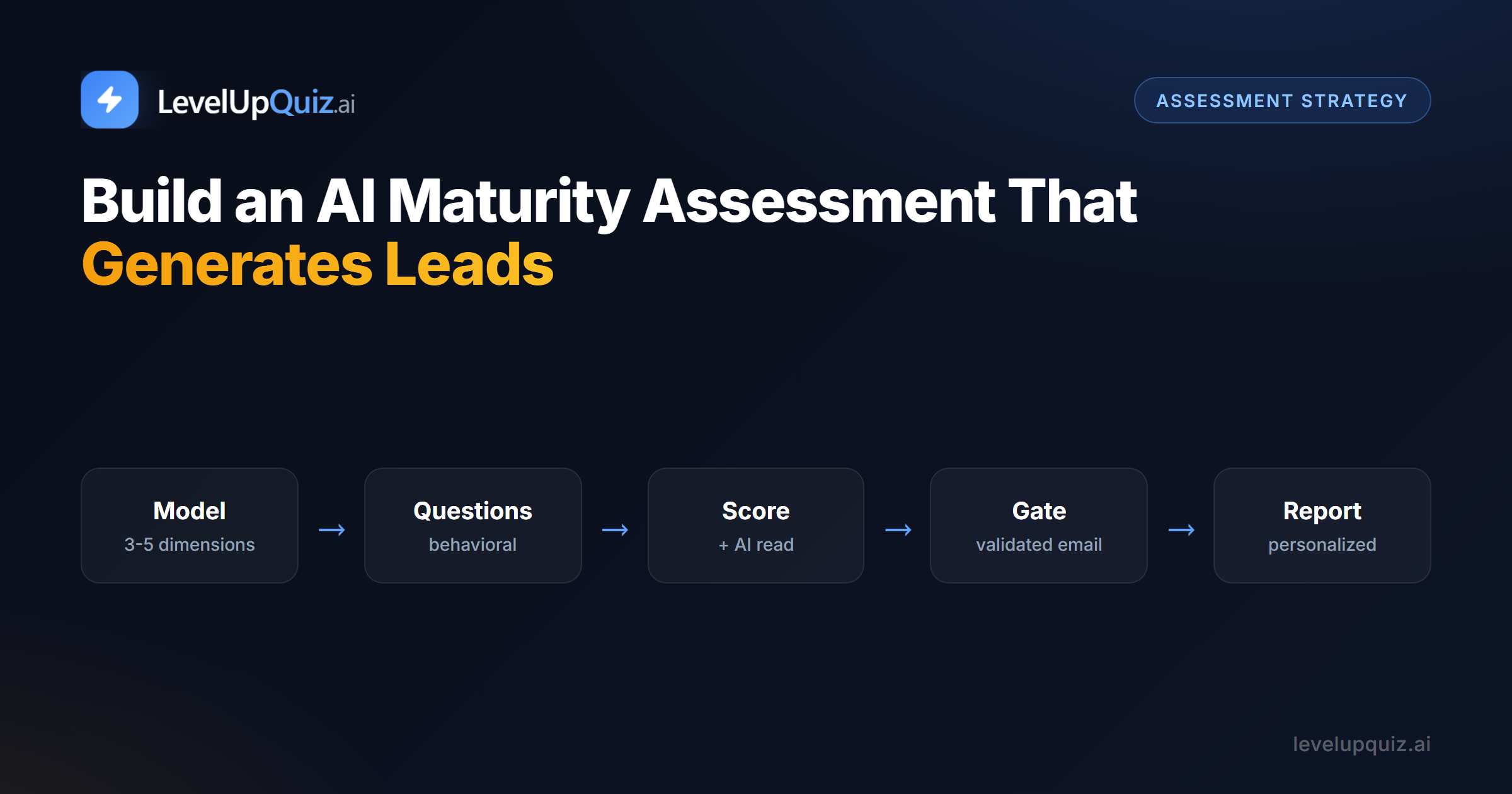
How to Build an AI Maturity Assessment That Actually Generates Leads
A step-by-step guide to turning your framework into a scored AI maturity assessment that delivers value and captures validated B2B leads.
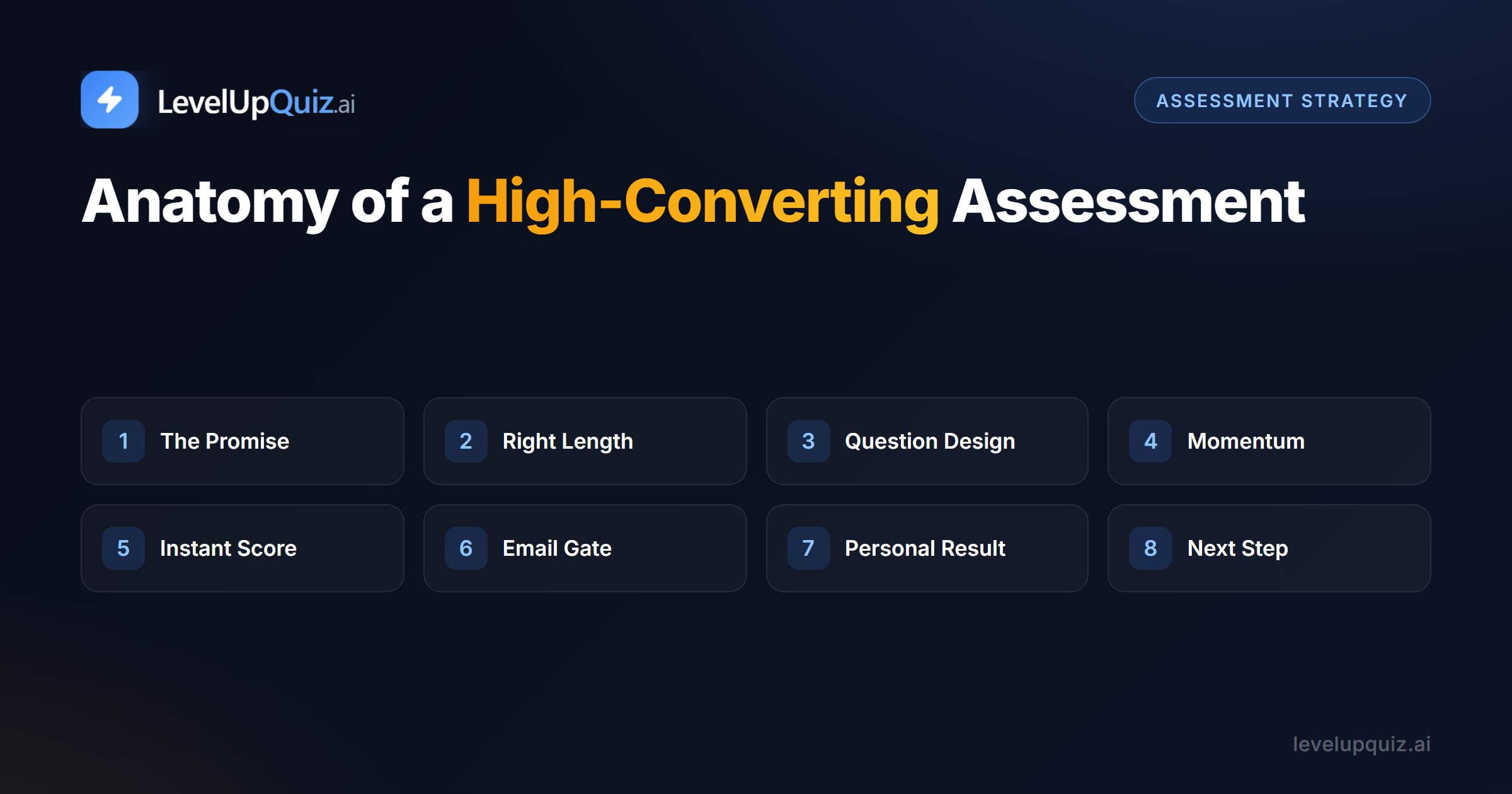
The Anatomy of a High-Converting B2B Assessment
The eight components that separate an assessment people finish and share from one they abandon on question three, from the promise to the personalized result.