Quiz Funnels vs. Lead Magnets: Why Assessments Convert Better
The downloadable PDF is dead weight. Here is why interactive assessments out-convert static lead magnets, and when each still makes sense.
Key Takeaways
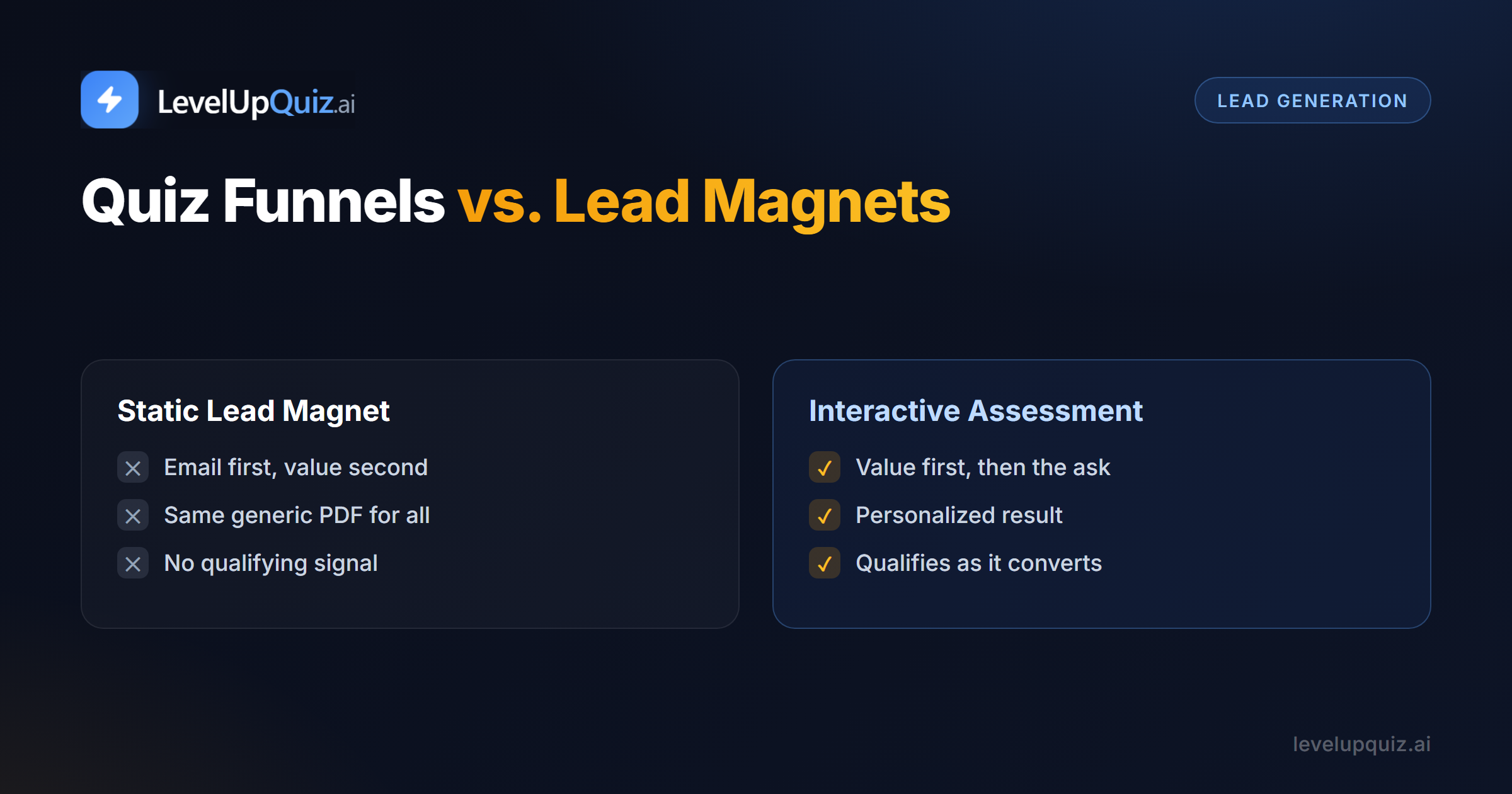
- Static lead magnets ask for an email before delivering any value.
- Assessments deliver a personalized result that earns the email instead.
- Quiz funnels capture qualifying data as a byproduct of the experience.
- Lead magnets still work for top-of-funnel reach; assessments win on quality.
Every B2B marketer has shipped the same lead magnet: a 12-page PDF behind a form. It worked in 2015. In 2026 the inbox is full, the form is friction, and the download goes unread. Interactive assessments change the trade, and for most considered B2B purchases, they convert better. Here is why, and how to make the switch without throwing away the content you already have.
The Problem With Static Lead Magnets
A lead magnet asks for the email first and delivers value second. The prospect has to gamble that the download is worth it. Most decide it isn't, and the ones who do often hand over a throwaway address. Three structural problems compound:
- The value is generic. Everyone gets the same PDF, so it can't speak to anyone's specific situation. A generic resource gets generic engagement.
- The exchange feels one-sided. You pay, with your email and attention, before you see whether the goods are any good. That's a bad trade, and savvy buyers know it.
- The data is thin. You capture an address and nothing else: no signal about who this person is, what they need, or whether they're remotely a fit.
The result is a long list that looks like progress on a dashboard and behaves like noise in the pipeline.
Why Assessments Flip the Trade
An assessment delivers value as the experience, not after it. The prospect answers questions about their own situation, gets an instant personalized score, and, wanting the full breakdown, trades a business email to unlock it. The value came first; the email is the fair price for more of something they already found useful.
The score is the hook. The full report is the offer. The email is the fair price for something the prospect already values.
That reordering is the whole game. You are no longer asking someone to bet on an unknown PDF. You are asking them to unlock the detail behind a result they are already holding, a far easier yes. And because the result is about them, it carries an emotional pull a static download never will.
The Psychology of Why It Works
The conversion lift isn't a trick of the format; it's a few well-understood human tendencies working in your favor.
People are drawn to information about themselves, a score about your pipeline is far more compelling than a generic guide about pipelines in general. Once someone has invested a few minutes answering, the effort already spent makes them want to see the result (a sunk-cost nudge working for the prospect, not against them). The instant score then opens a curiosity gap, "Level 2 of 5? Why? How do I get to 3?". That the gated breakdown promises to close. And because you gave real value before asking for anything, reciprocity makes the email feel like a fair return rather than a toll.
None of this is manipulation; it's alignment. The prospect genuinely wants the answer, and you genuinely have it. The format simply sequences the exchange so both sides feel they got the better end of the deal.
What Actually Makes a Quiz Funnel Convert
It's tempting to credit the format itself, but a quiz funnel converts for specific, repeatable reasons, and missing any one of them sinks it.
The first is a promise about the reader: "How does your pipeline compare to teams that have fixed the leak?" pulls because it's about them; "Take our quiz" doesn't. The second is an instant, ungated result, the score has to appear the moment they finish, before any email ask, or you've recreated the lead-magnet problem. The third is genuine personalization: the full breakdown must reflect their answers, not a stock paragraph everyone receives. The fourth is a fair gate, give the score freely, charge an email only for the depth.
Get those four right and the mechanics take care of themselves. Get them wrong, gate the score, ship a generic result, over-ask at the form, and the interactive format won't save you. A quiz funnel isn't magic; it's a value-first sequence, and the sequence is the whole point.
Qualifying Data as a Byproduct
Here is the part that matters most downstream. Because the prospect answered questions about their situation to get their score, every captured lead arrives pre-qualified:
- You know their maturity level or segment before sales ever calls.
- You can route and prioritize based on real answers, not guesses.
- The first conversation starts with their problem, not your pitch.
A lead magnet gives you an email. An assessment gives you an email attached to context, which is the difference between a list sales quietly ignores and one it actually works.
When Lead Magnets Still Win
This isn't all-or-nothing, and pretending otherwise would be dishonest. Static content still earns its keep in two places:
- Search traffic and authority. A genuinely useful, well-ranked guide pulls in visitors an interactive quiz won't, and builds the credibility that makes people trust your assessment in the first place.
- Top-of-funnel reach. For broad, low-commitment awareness, a downloadable resource is a frictionless entry point.
The smart play is not to choose. Use ranked guides and resources for reach, and an assessment as the conversion step they funnel into, rather than treating the PDF as the finish line.
How to Turn a Lead Magnet Into a Quiz Funnel
If you already have a lead magnet that earns downloads, you have the raw material for an assessment. Convert it in four steps:
- Find the diagnosis hiding in your guide. Most how-to lead magnets quietly assume the reader has a problem. Name it, and turn "here's how to fix X" into "find out how bad your X actually is."
- Extract the scored dimensions. The sections of your guide are usually your scoring categories. A guide with five chapters is often a five-dimension assessment waiting to happen.
- Write behavioral questions for each dimension. Two to four per category, anchored in what the respondent actually does, not what they wish they did.
- Gate the depth, not the score. Show the result instantly; put the personalized breakdown, and the original guide's advice, now reframed as their action plan, behind a validated business email.
You keep the content you already wrote. You just reframe it from "download and read someday" to "diagnose and act now."
A Concrete Example: From Guide to Scorecard
Suppose you have a popular lead magnet: a guide called "The B2B Pipeline Leak Audit." It gets downloads, but the list it builds is cold. Here's the conversion.
The guide already implies a diagnosis. Your pipeline is leaking somewhere, so the assessment promise writes itself: "Find out where your pipeline is leaking." The guide's five chapters (targeting, qualification, follow-up, forecasting, retention) become five scored dimensions. For each, you write three behavioral questions: "We can name why we lost our last ten closed-lost deals," "Every inbound lead gets a first response within an hour," and so on.
The respondent finishes, immediately sees "Your biggest leak: Follow-up (Stage 2 of 5)," and trades an email to unlock the full breakdown, which is, essentially, the relevant chapters of your original guide, now reordered as their prioritized action plan.
Same content, completely different funnel. The PDF asked strangers to read forty pages on faith. The assessment hands them a personalized diagnosis and delivers the guide as the reward. One builds a cold list; the other generates qualified conversations.
Common Quiz-Funnel Mistakes
Most quiz funnels that underperform make one of a few predictable errors:
- A personality quiz in disguise. "Which growth archetype are you?" drives clicks but produces a result no serious buyer will trade a business email for. Diagnose, don't entertain.
- Gating the score. Hiding the result behind the form recreates the exact lead-magnet problem you were trying to escape.
- A generic result. If everyone gets the same three paragraphs, the personalization promise is broken and trust goes with it.
- Too long for the payoff. Twenty-five questions for a one-line verdict is a bad trade; respondents abandon partway through.
- No next step. A great result with no clear action wastes the attention you just earned.
The Honest Tradeoffs
Go in with your eyes open on two things. First, raw lead volume often drops. You are filtering, by design. If your team is measured purely on download counts, expect friction until everyone agrees quality is the goal. Second, an assessment takes more thought to build than a PDF: it needs a real model, well-written questions, scoring logic, and a result worth gating. The payoff is leads that convert and conversations that start warm, but it is a build, not an afternoon's work.
Measure the Right Thing
The most common mistake after launching a quiz funnel is judging it by opt-in rate alone. Opt-in matters, but it's a vanity metric if the leads don't convert.
Track three things instead. Completion rate tells you whether the promise and length are honest, heavy drop-off means too many or too abstract questions. Lead quality, real business emails, right-fit segments, tells you whether the experience attracts and qualifies the people you want. And downstream conversion, how those leads progress versus your old lead-magnet list, is the number that actually decides whether the switch was worth it.
Expect raw volume to fall and quality to rise. If you only watch volume, a successful quiz funnel can look like a failure; watch quality and conversion, and the trade reveals itself.
Start With One Assessment
You don't need to replace your whole content program to test this. Pick the one lead magnet that already earns the most downloads and convert just that one into an assessment using the four steps above. Keep everything else as-is.
Then run them side by side for a few weeks: same traffic sources, the old PDF on one path and the new assessment on the other. Compare not the opt-in rates but the downstream quality, which path produced leads your sales team actually wanted to call. That single comparison usually settles the debate faster than any best-practice article, because it's your audience and your offer. If the assessment wins, expand from there; if it doesn't, you've spent one conversion, not your whole funnel.
The Takeaway
Stop asking for the email before you've earned it. Build the value into the experience, let the prospect see themselves in the result, and let the assessment do your qualifying for you. The lead magnet isn't dead. It's just demoted from the finish line to the on-ramp.
Frequently Asked Questions
Related Articles
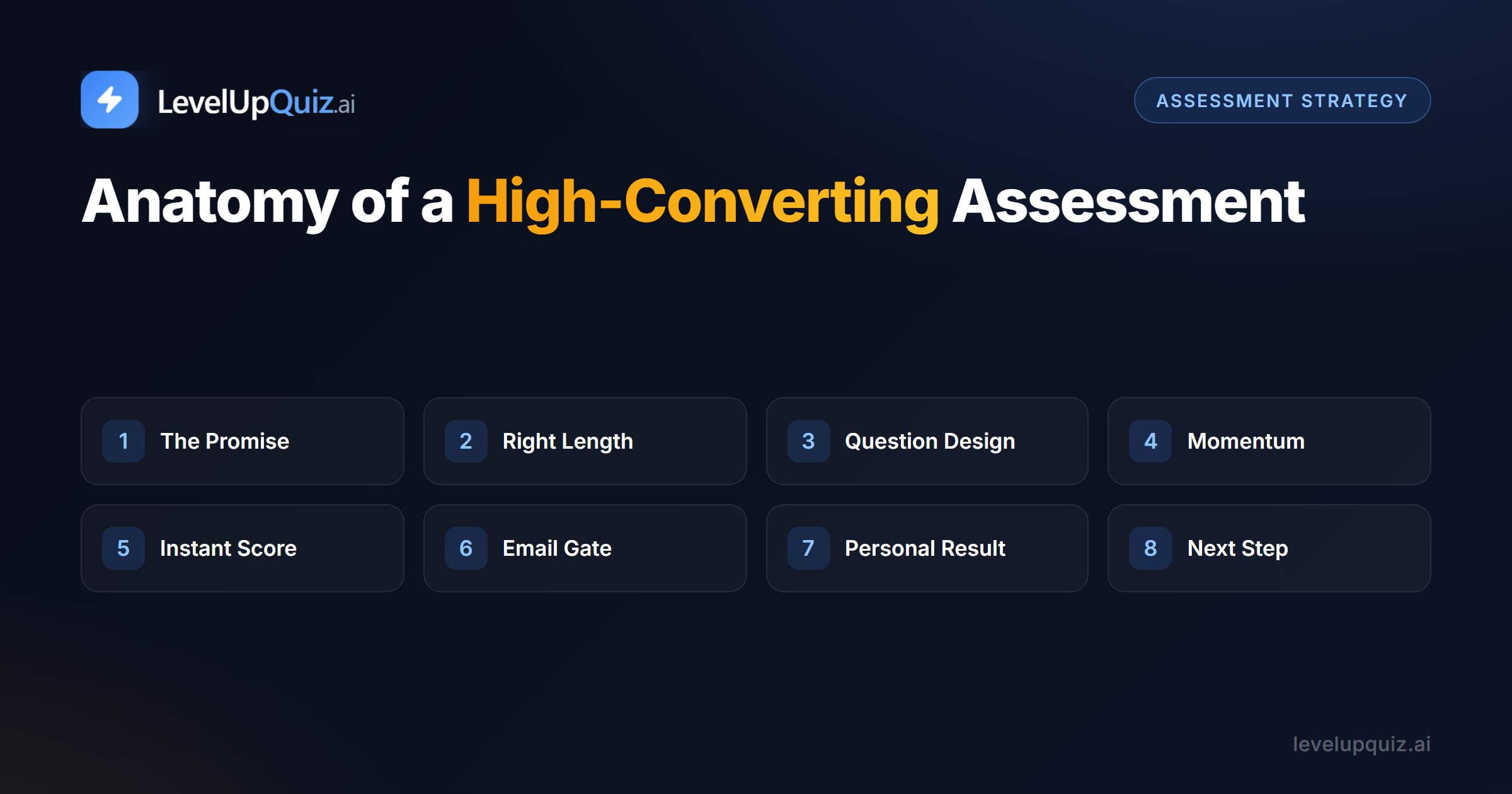
The Anatomy of a High-Converting B2B Assessment
The eight components that separate an assessment people finish and share from one they abandon on question three, from the promise to the personalized result.
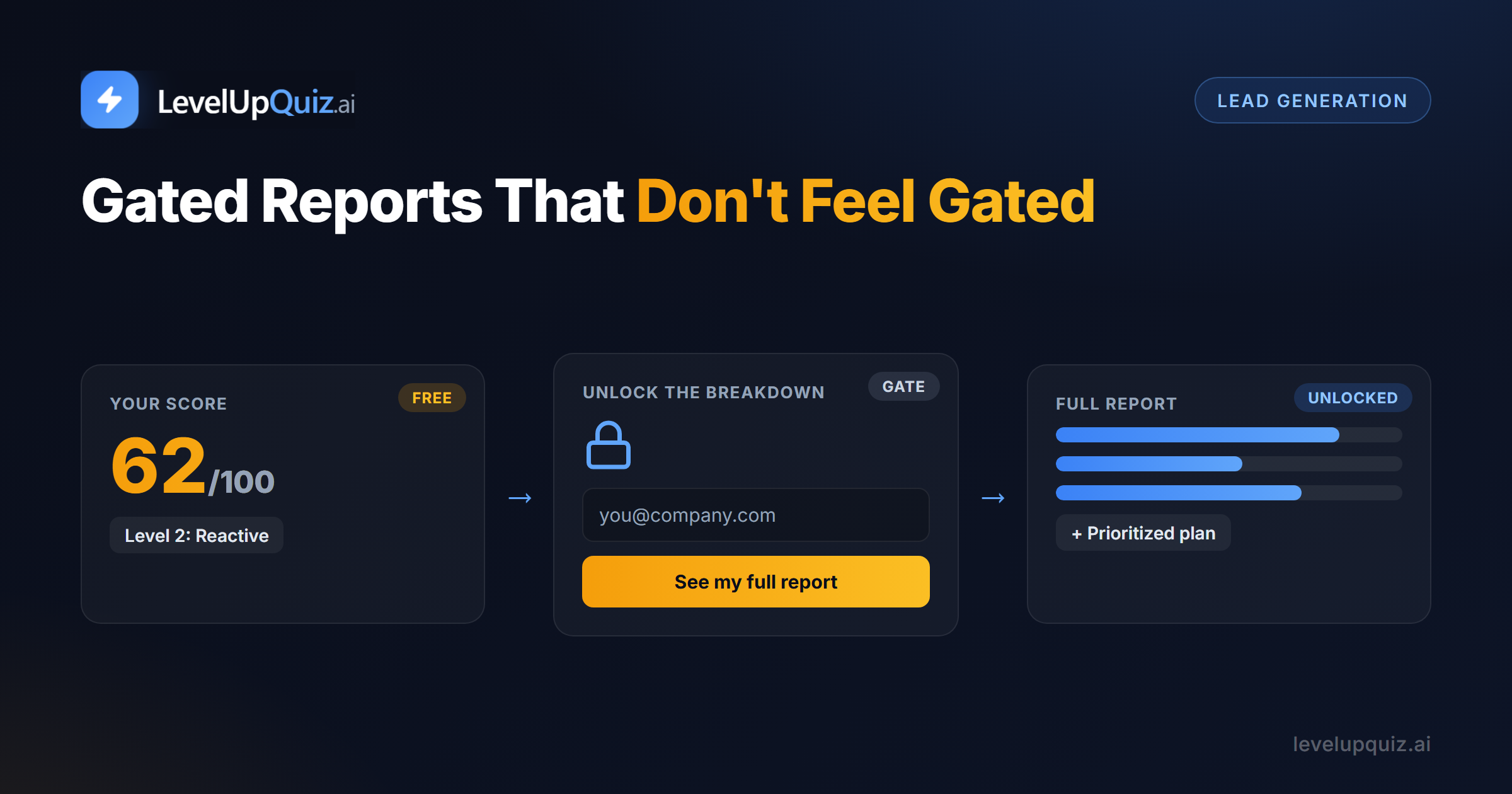
Gated Reports That Don't Feel Gated: The Value-First Playbook
Capture validated business emails without the bait-and-switch, by giving real value before, during, and after the gate. The value-first lead-capture playbook.