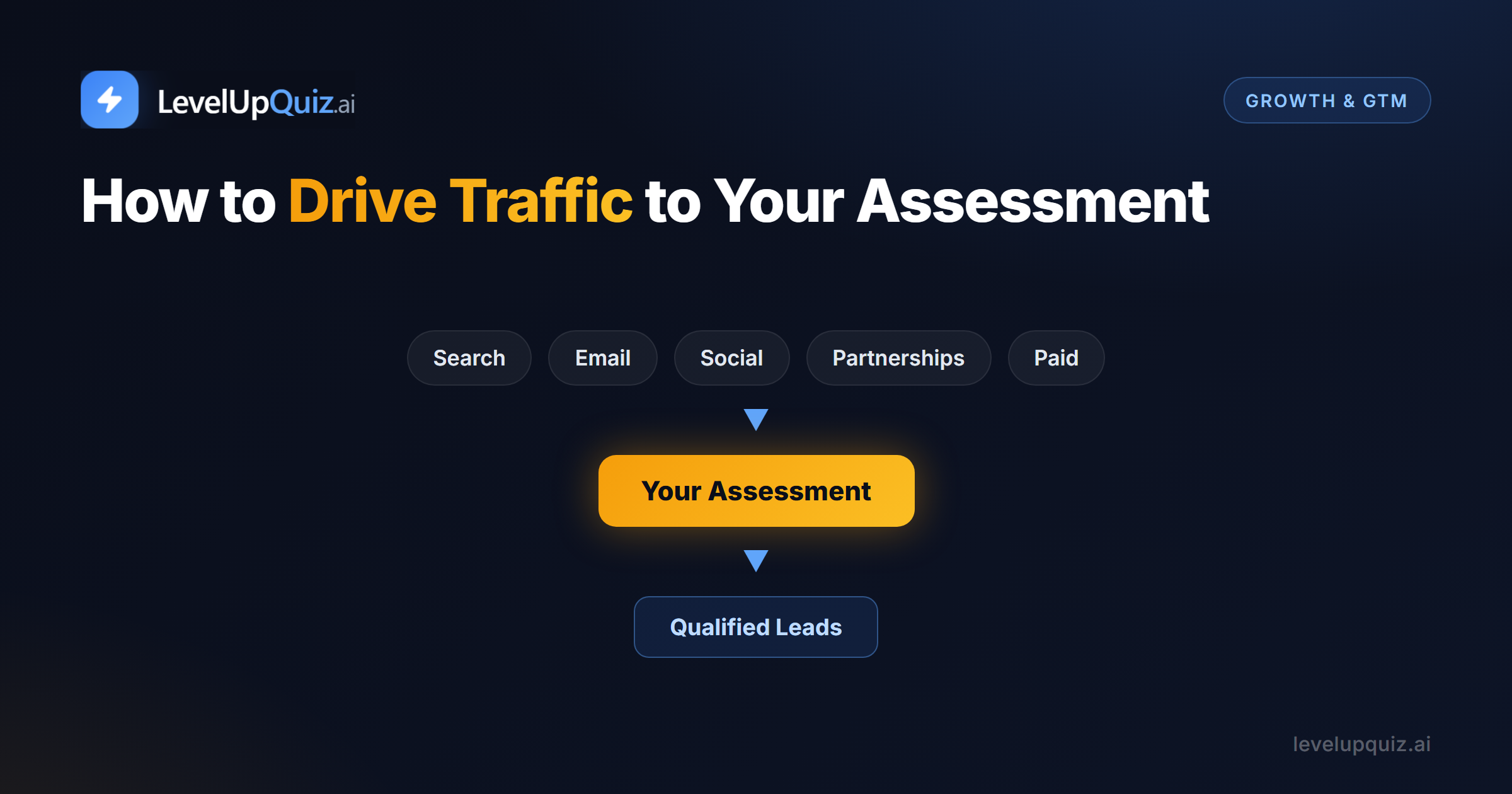
How to Drive Traffic to Your Assessment
Five repeatable channels for getting the right people to your quiz, from search to email to partnerships.
Key Takeaways
- A great assessment with no traffic captures no leads, distribution is half the job.
- Search, email, social, partnerships, and paid each feed the same quiz.
- Match the channel to where your buyer already spends attention.
- Every channel should point to one high-converting assessment, not scattered CTAs.
You can build the best assessment in your category, but if no one takes it, it captures no leads. Distribution is half the job, and the half most teams underinvest in. The good news: you don't need a viral moment or a huge ad budget. You need a handful of repeatable channels, each pointed at the same quiz. Here are five that work, how to run each, and how to tell which are paying off.
Start Where Attention Already Exists
Before picking tactics, pick the audience you can already reach. The highest-return distribution almost always starts with attention you've earned or borrowed. Your list, your network, a partner's audience, not with cold strangers. Cold channels like SEO and paid are worth building, but they compound slowly. Sequence accordingly: warm first, cold second.
1. Search
Search is the compounding channel. The move is to target the exact questions your assessment answers, "how mature is our go-to-market?", "is our team AI-ready?", "where is our pipeline leaking?" Write a genuinely useful page for each query, and make the assessment the natural next step on that page rather than a buried link.
The page earns the ranking; the assessment earns the lead. Don't treat the article as the finish line, treat it as the doorway. One well-ranked page that funnels into your quiz can generate qualified leads for years, long after you've stopped touching it.
2. Your Email List
Your list is the warmest traffic you have, and it's already opted in. A single, well-framed send, "find out where you stand", routinely outperforms a generic newsletter link, because it offers the reader something about themselves rather than something to read.
Segment if you can: a relevance line ("for RevOps leaders") lifts response. And don't send once and forget it, a result-driven assessment is worth a re-send to non-openers and a periodic re-run as your benchmark data grows and the comparison gets richer.
3. Social and Communities
On social, share the result type, not just the link: "Most teams think they're Level 4. Most are Level 2. Find out where you land." Curiosity about a comparative result travels far further than "take our quiz." A score is inherently shareable, people compare.
Communities, Slack groups, subreddits, forums where your buyers gather, work when you lead with the insight, not the link. Post the surprising pattern your assessment reveals and let the quiz be how someone finds their own number. Drive-by link drops get ignored; genuine insight gets clicks.
4. Partnerships
Partnerships are the fastest way to reach qualified strangers, because you borrow trust. Co-brand the assessment with a complementary company, a newsletter, or a community whose audience overlaps yours but who doesn't compete. They get a value-add for their audience; you get warm reach into it.
The best partner assessments are framed around the partner's audience, "the [Newsletter] Readiness Scorecard." A referral from a source the prospect already trusts converts far better than a cold ad, because you inherit the relationship instead of starting from suspicion.
5. Paid
Paid traffic to an assessment can pay back precisely because the personalized result lifts conversion above a typical landing page. You're sending clicks to an experience, not a static pitch. Start small, on one channel, with one clearly defined audience.
The number to watch isn't cost per click or even cost per lead. It's cost per qualified lead, because the assessment filters as it converts. A channel that looks expensive on raw leads can be cheap on qualified ones. Scale what pays back on that metric; kill what doesn't.
Point Everything at One Assessment
The most common distribution mistake is scattering: three lead magnets, two quizzes, a webinar, and a newsletter, each pulling in a different direction. Concentrate instead. Pick one high-converting assessment and make it the destination for every channel.
Concentrated traffic into one well-built funnel beats diffuse traffic into many half-built ones. It also pushes enough volume through a single experience for you to actually learn and improve it, and every improvement compounds across every channel feeding it.
A Simple Launch Sequence
Starting from zero, run the channels in order of warmth:
- Week 1, Email. Send it to your list. This is your fastest signal on whether the assessment resonates at all.
- Week 2, Social and communities. Share the result type and the surprising insight; seed it where your buyers already gather.
- Weeks 2-4, Partnerships. Line up one or two co-brand or newsletter placements.
- Ongoing, Search. Publish the question-targeted pages that compound over months.
- Once converting, Paid. Only pour budget into a funnel you've already watched convert warm traffic.
Warm channels validate the assessment cheaply; cold channels scale it once you know it works.
Measure the Right Thing
Judge channels by qualified leads and the conversations they produce, not raw clicks or even raw completions. A channel that sends a flood of traffic that never finishes the quiz, or finishes but never fits, is worse than a smaller channel that sends ready buyers.
Track, per channel: completion rate (does this audience engage?), lead quality (right-fit, real emails?), and downstream conversion (do these leads progress?). The channel rankings by clicks and by qualified pipeline are often completely different, trust the second.
Build a Distribution Flywheel
The channels above aren't independent, run together, they compound. Search brings in strangers who, once they take the assessment, join your email list. Your email sends drive social shares of the result. Social visibility makes partners more willing to co-promote. Partner placements build the backlinks and brand searches that lift your SEO. Each channel feeds the next.
The implication: don't think of distribution as a list of one-off campaigns, but as a loop you're trying to spin faster. Every completion should feed the loop, capture the email, invite a share, and use the aggregate data to make the next piece of content sharper. A flywheel started with one channel and patiently connected to the others beats a series of disconnected pushes that each start from zero.
What to Put on the Landing Page
Traffic only matters if it starts the assessment, and that hinges on the landing page. Keep it ruthlessly focused on a single action: take the assessment. Lead with the promise, a specific, comparative, about-the-reader headline. Show the payoff (what result they'll get), strip out competing links and navigation that invite people to wander off, and make the start button impossible to miss.
Social proof helps if it's honest, how many people have taken it, a credible logo, a one-line testimonial. But the biggest lever is the promise itself. A page that clearly answers "what will I learn about myself, and is it worth two minutes?" converts; a page that buries that under company boilerplate doesn't. Test the headline before you test anything else.
How Much Traffic Do You Actually Need?
It's worth doing the rough math, because it reframes the goal. Say your landing page converts 40% of visitors into assessment-starters, 70% of starters finish, and 50% of finishers hand over a business email. That's a visitor-to-lead rate of about 14%. To get 100 qualified leads a month, you need roughly 700 relevant visitors, not tens of thousands.
That math is freeing: you don't need viral scale, you need a few hundred right people. It also tells you where to focus. If your conversion rates are healthy, pour effort into reach; if they're poor, fix the promise and the result before you buy more traffic. A modest, well-targeted stream into a high-converting assessment beats a flood into a leaky one.
Squeeze More From Every Run
A distributed assessment generates two assets, not one: the leads, and the aggregate data. Use both. Re-run the assessment periodically and you build a benchmark, "the state of GTM maturity in 2026", which is itself a piece of content worth promoting, and which makes everyone's individual result more compelling ("you're in the bottom third").
Repurpose the aggregate findings into posts, talks, and social hooks, each pointing back to the assessment. The data you gathered to qualify leads doubles as the raw material for the content that attracts the next wave. One assessment, run continuously, becomes a renewable content and distribution engine rather than a one-time campaign.
Don't Spread Yourself Thin
Pick two channels to start, not five. Distribution rewards depth over breadth early on: one channel you run consistently and learn from beats five you dabble in. For most B2B teams, the opening pair is email (warmest) plus one of search or partnerships (to reach beyond your list). Add channels only once the first two are humming and you have spare capacity, a half-run channel produces half-results and muddies your read on what's actually working.
A 90-Day Distribution Plan
A concrete starting cadence. Month 1: ship the assessment, send it to your full list, and seed it in two communities where your buyers gather. Month 2: line up one partnership or newsletter placement, and publish your first two question-targeted SEO pages. Month 3: re-send to non-openers with a sharper subject line, publish two more pages, and, only if the funnel is converting warm traffic, turn on a small paid test.
By day 90 you'll have a warm-traffic baseline, the first signs of compounding search, one borrowed audience, and a data-backed read on whether paid is worth scaling. That's a flywheel starting to turn, not a one-off launch.
Treat the Hook as the Product
Whatever the channel, the words that wrap the link do most of the work. The same assessment buried under "Check out our new tool" and surfaced as "Most teams overestimate their GTM maturity by a full stage, see where you really land" perform nothing alike. Spend disproportionate time on the one-line hook for each channel; it's the highest-leverage copy in the whole funnel, and it's the cheapest thing to test.
Common Distribution Mistakes
- Building it and waiting. An assessment is not a field of dreams; traffic doesn't arrive on its own.
- Scattering CTAs. Many destinations means none gets enough volume to improve.
- Judging by clicks. Optimize for qualified leads, or you'll scale the channel that sends the most tire-kickers.
- Cold before warm. Spending on ads before testing the assessment on your own list wastes budget validating something your list could have validated for free.
Build the assessment once; then feed it, deliberately, from the channels where your buyers already are.
Frequently Asked Questions
Related Articles
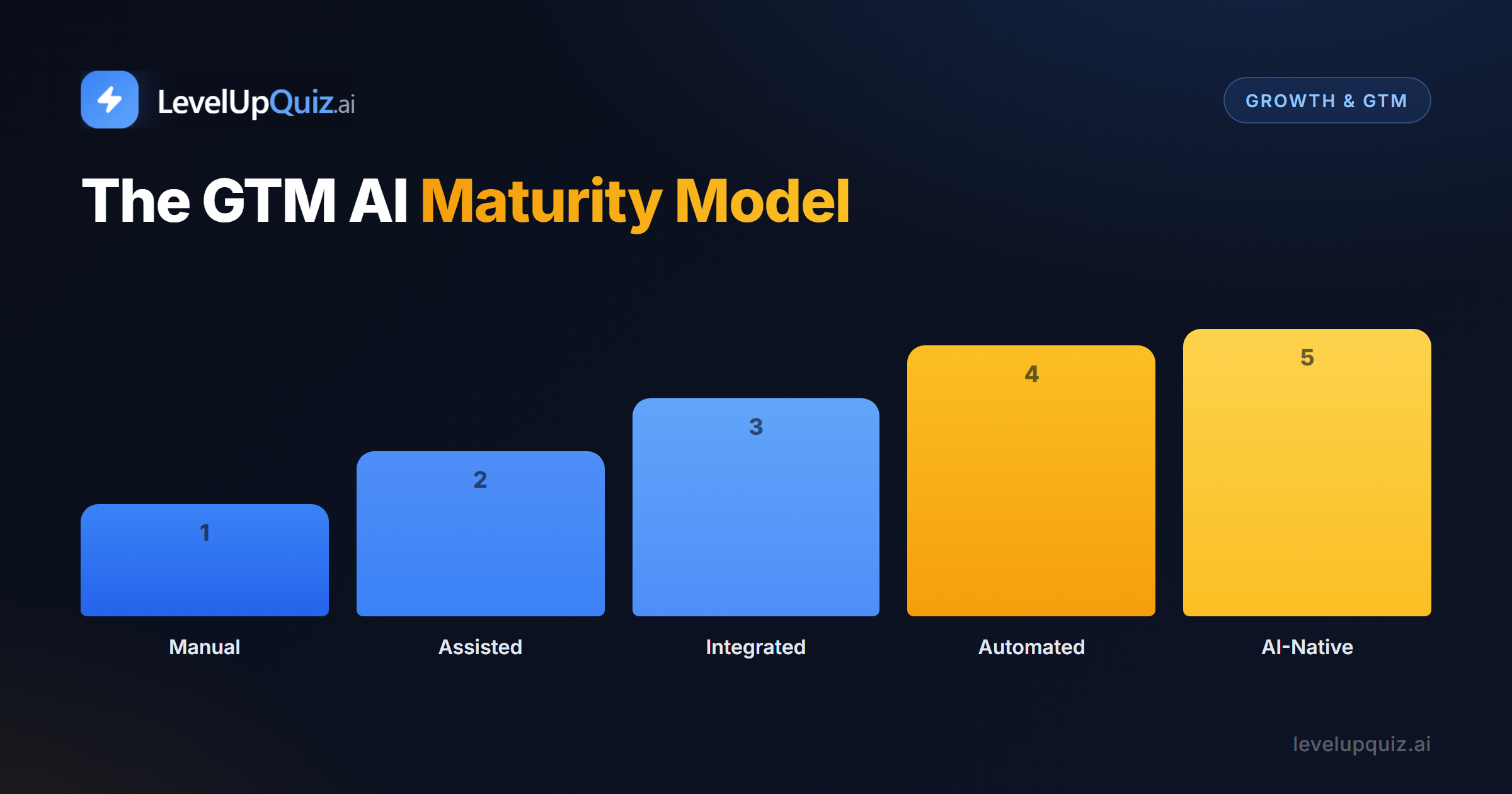
The GTM AI Maturity Model, Explained
A five-stage model for go-to-market AI maturity, from manual processes to an AI-native growth engine, and how to find your stage.
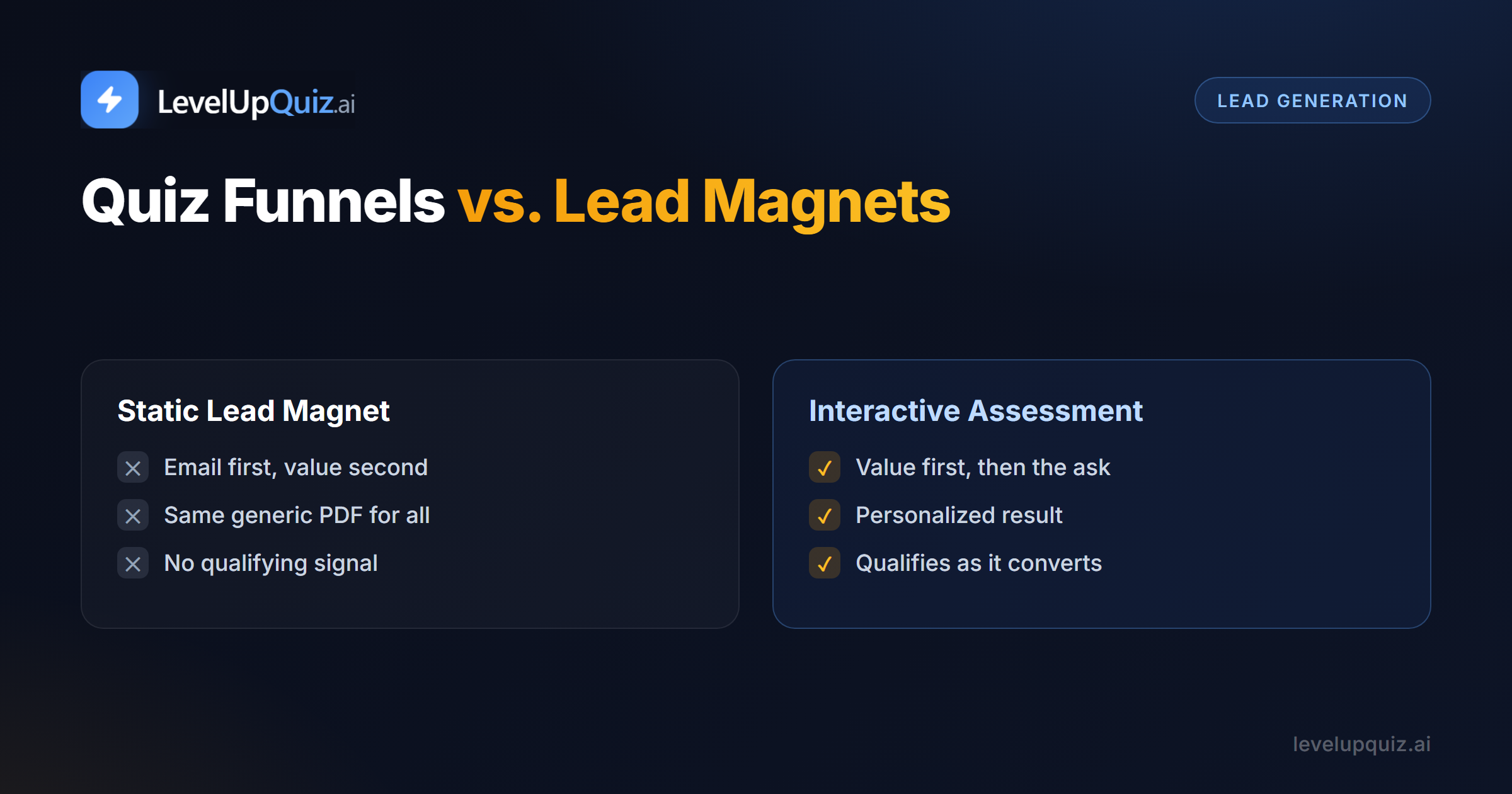
Quiz Funnels vs. Lead Magnets: Why Assessments Convert Better
Static lead magnets ask for the email before giving value. Assessments flip that, delivering a personalized result that earns the opt-in. Here is the breakdown.
Assessment-Led Marketing in Practice: What Actually Changes
Put a scored assessment at the front of your funnel and the metric that matters flips from lead volume to lead quality. The honest breakdown, including where it falls short.